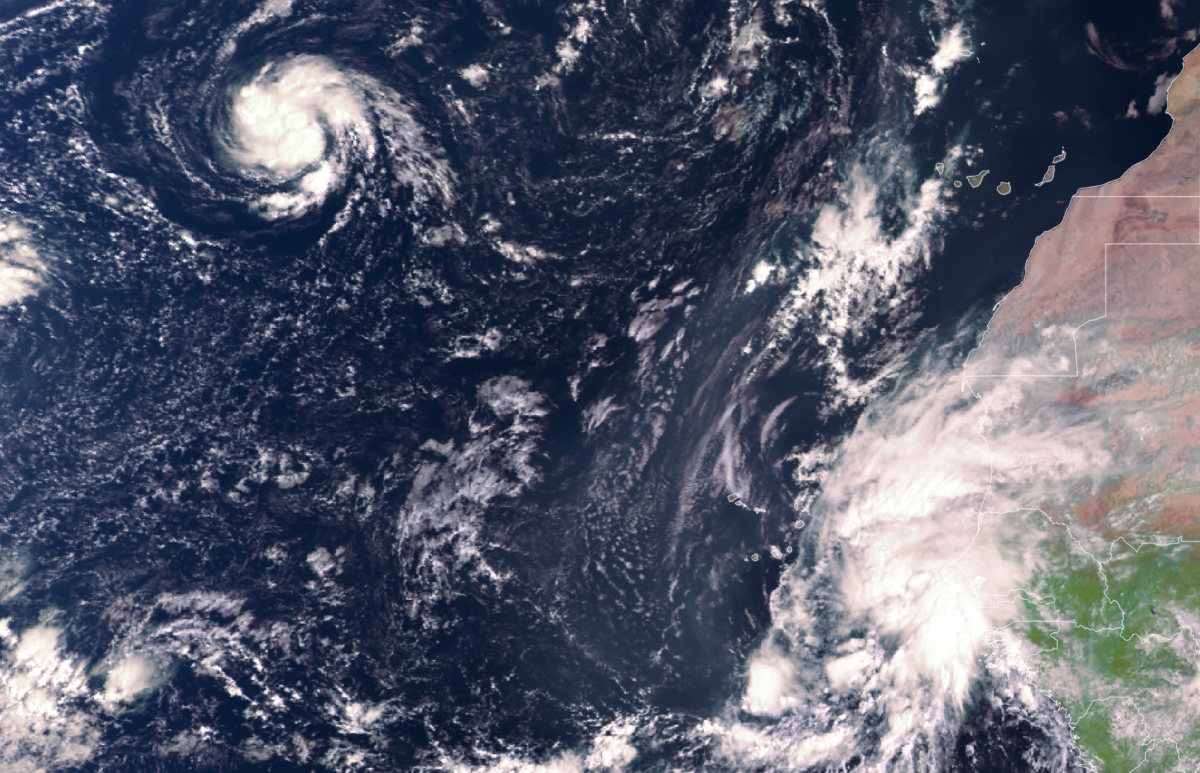
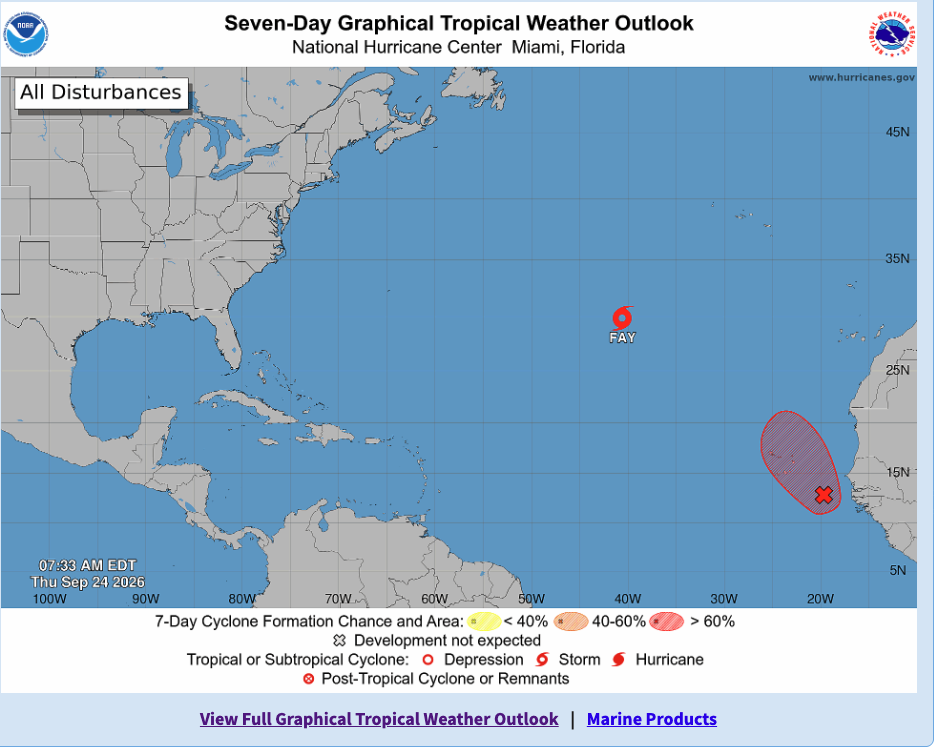
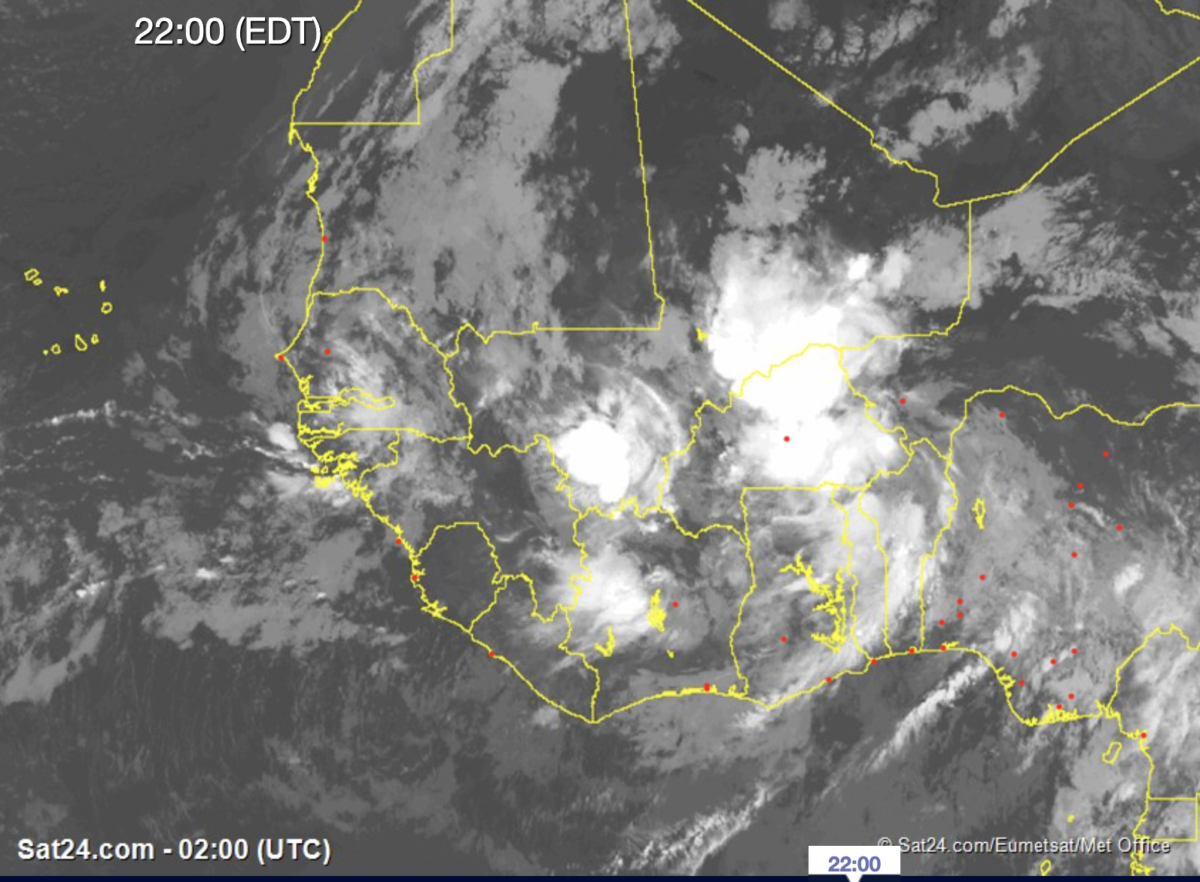
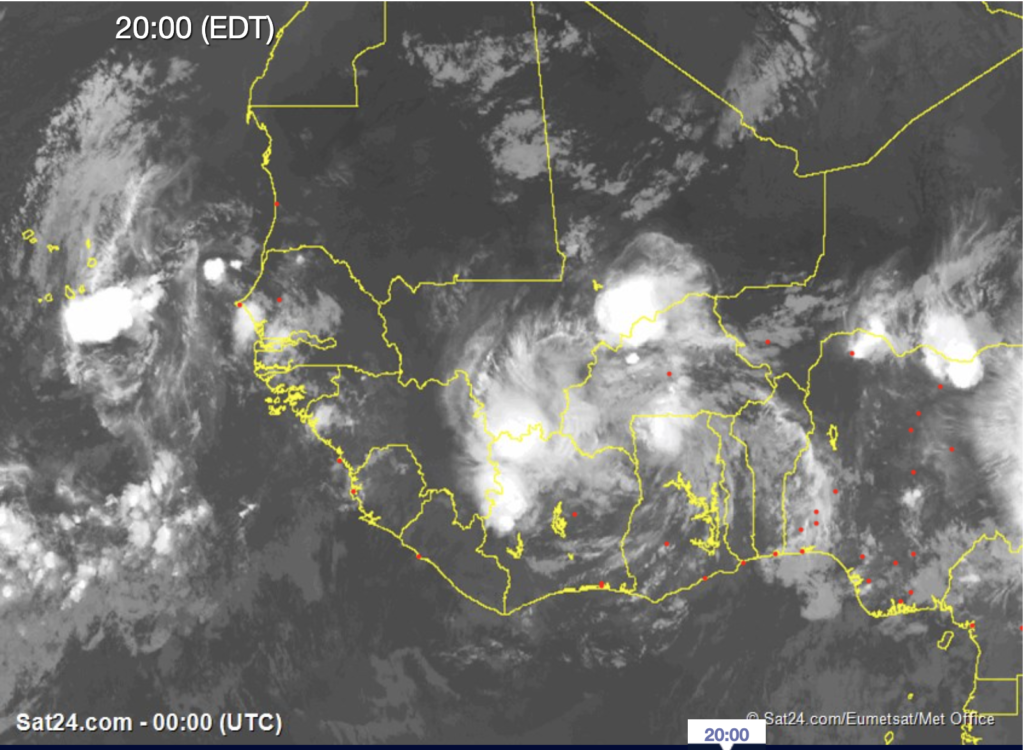
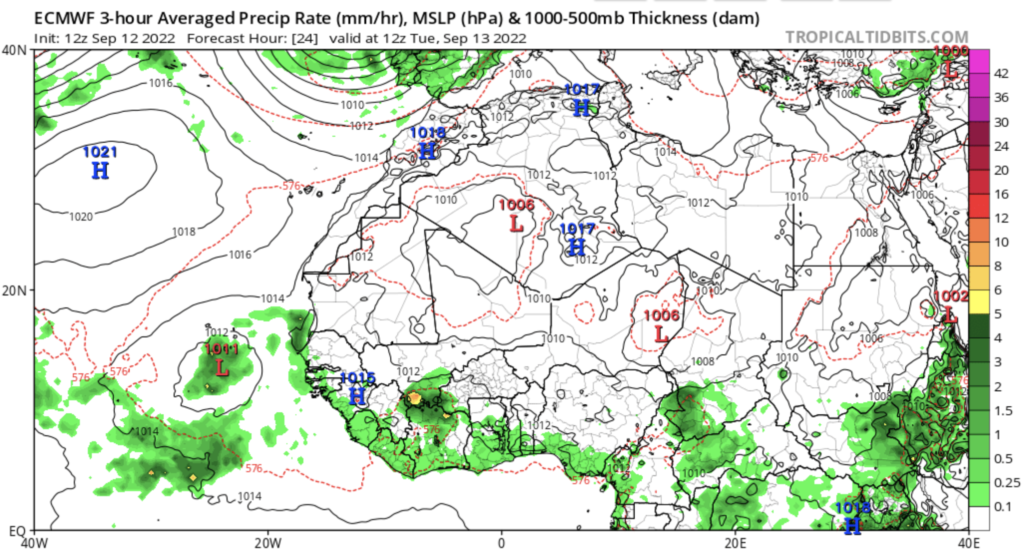
This year has been devoid of tropical systems, and the main source of tropical cyclones in the Eastern Atlantic – African Easterly Waves (AEWs) have been very weak. Tropical storm Fay has been around for a number of days and has been one of the few tropical cyclones that look healthy during this super El Nino. However, a wave emerged off the coast of Africa in the last 48 hours. The National Hurricane Center gives this disturbance a 70% chance of becoming a tropical depression before upper-level winds limit its development.
8 AM National Hurricane Advisory with 70% chance of formation.
MODELS DIFFER IN THE TRAJECTORIES OF THE EVENT
The US model (GFS) and the Hurricane WRF models suggest the disturbance will stay east of Cabo Verde. It would move north and slowly weaken. In contrast, the ECMWF and Canadian models suggest the storm passes over Cabo Verde, potentially as a tropical depression, from late tonight through Saturday. The key to its path is an upper-level low, which will guide the disturbance’s direction. If the upper-level low is strong (as suggested by GFS), its influence will pull the storm more to the Northeast. If the upper-level low is weak to moderate, it will have less of an influence on turning the disturbance north, and it will have a bigger impact on Cabo Verde.
POTENTIAL THREATS TO POPULATIONS
SENEGAL
Currently, the storm is just off Senegal’s coast. Over the next day, as it moves north or west, it could bring heavy rain, strong winds, and high waves that may cause coastal flooding. Dakar and coastal communities may experience flooding from both coastal flooding and heavy rain.
CABO VERDE
If the storm tracks westward, trouble could be on the way. The ECMWF and Canadian models show the storm hanging out over the area for 1-2 days with the potential of strong winds, high waves, and heavy rains. Based on these models, the northern islands would see the strongest winds over the next 48 hours. The rain could also cause flooding, with rain bands passing by all of the islands leading to flooding.
Prepare either Way
Residents of Cabo Verde and Senegal should be prepared for the potential impacts of this storm. Senegal should be prepared for flooding today. Cabo Verde should expect poor weather to begin tonight and potentially through Sunday. Fishermen should expect high waves to impact them in the next 24-48 hours and should not go out to sea without some guidance. People should not panic, but should make sure they have the necessary items to ensure their safety. Areas prone to flooding or that could be impacted by strong winds should take note.
Residents in Cabo Verde and Senegal should follow the news and their national weather forecast offices for updates.
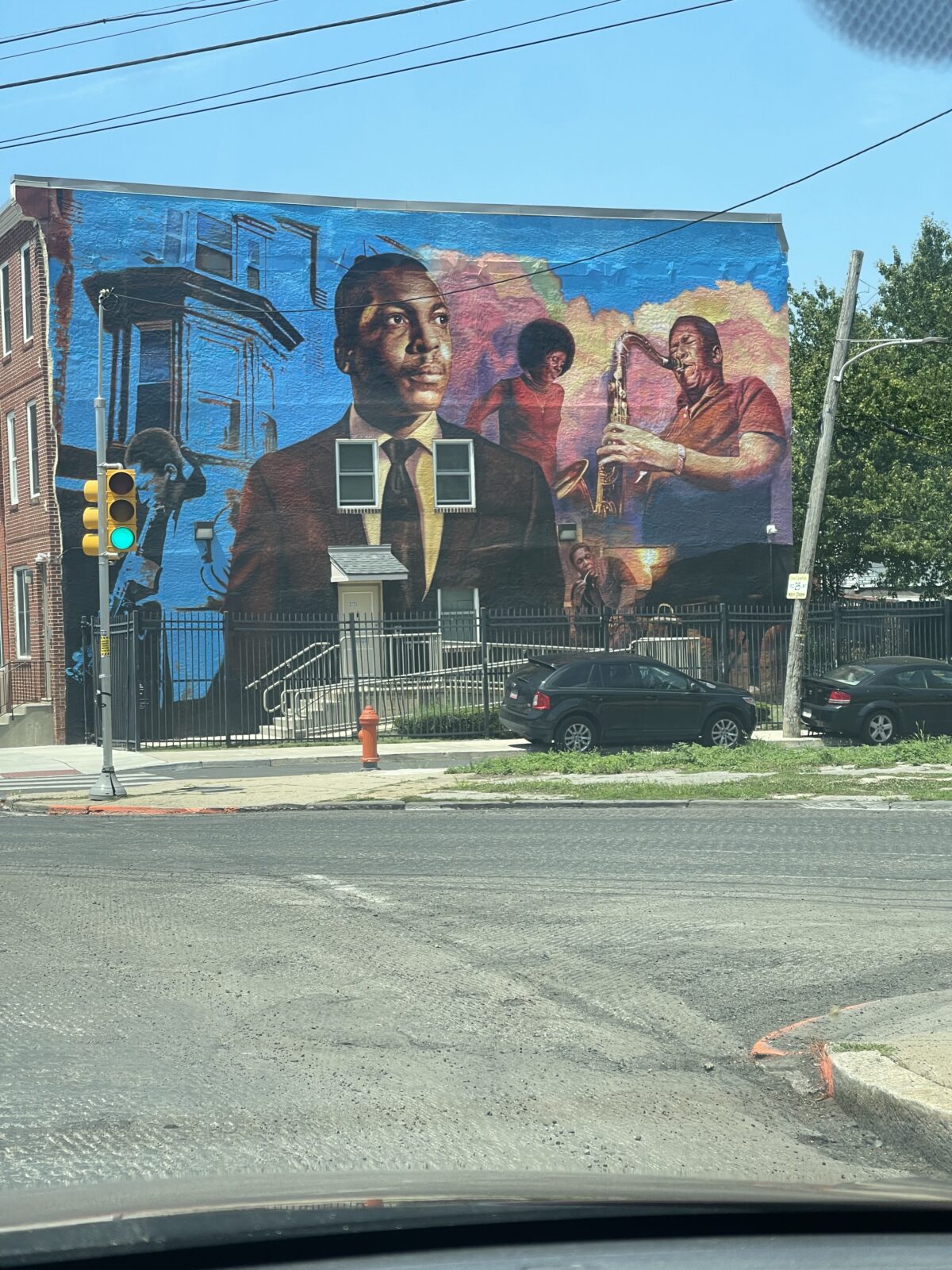
Philly is an amazing place that most people either hate or love. I love it and the people who live there. There is a certain level of authenticity in both the good and bad. Still, Philly is special and has always been a sanctuary city. In the 1800s, during the enslavement of black folks, Philadelphia was one of the first stops for Harriet Tubman after making a dangerous trek through the slave states of Maryland and Delaware along the Underground Railroad. The city is known for producing great talents like John Coltrane, Philly Joe Jones, Ella Fitzgirld, Christian McBride, The Roots, and Will Smith. The sports scene is crazy with the Eagles, Phillies, Flyers, and Sixers. AI, Dr. J, Maurice Cheeks, Moses Malone, Charles Barkley, Randall Cunningham, Jalen Hurts, and Penn State’s Saquon Barkley are household names. It’s personal… like we know them. Now we got the King and Jaylen Brown….. Clutch
I grew up in West Philadelphia’s Mantua section, otherwise known as the Black Bottom. This was the area of the city that my parents chose to raise us when they finally purchased their house in the 1950s after migrating from North Carolina and South Carolina and serving in World War II. However, in the mid-1930s, the Home Owners’ Loan Corporation (HOLC) redlined this area and many other neighborhoods in the United States and designated it D20, an undesirable location by banks. All of this was in response to Black Americans moving north.
As millions migrated from the South, whites in northern cities such as Baltimore, Philadelphia, Harrisburg, Lancaster, PA became alarmed. With the help of the US government, HOLC maps were created (https://www.youtube.com/watch?v=cUl3l4w5CYw). Banks provide homeowner’s loans based on the designations A, B, C, and D, with D locations being undesirable. People of color were designated to live in the D zones. Highways were built near these zones so that white Americans could travel back and forth to their suburban zone. Polluting industries such as power plants and railroad zones were often near these neighborhoods. More importantly, divestment in redlined neighborhoods became the norm, with limited school funding and community businesses while accelerating poverty and disenfranchisement.
Redlined areas of Philly have issues today such as highest poverty rates in Pennsylvania. The city today is expensive (gentrification); driving can be dangerous because folks run lights and stop signs, and many neighborhoods have a high prevalence of high blood pressure, obesity, diabetes, cardiovascular disease, and asthma… In West Philly, one of the redlined zones, the life expectancy is 11 years lower than in non-redlined zones. My parents, aunts, and uncles who are from D-20 never lived to collect Social Security. My dad died just before his 55th birthday tnd my mom just before her 55th birthday, from brain hemmorage and high blood pressure-related kidney failure. My aunts and uncles and friends who lived in West Philly died from diabetes, heart attacks, and stroke. It was not only their six kids who suffered from their loss, but my folks were never given the opportunity to have memories like proms, high school and college graduation for the three youngest kids or to see their grandchildren born. This situation is not exceptional but the norm in many redlined neighborhoods in the United States.
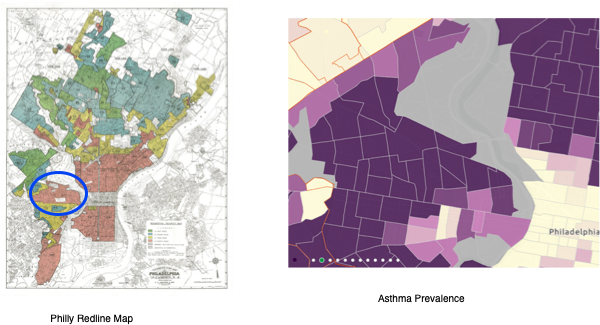
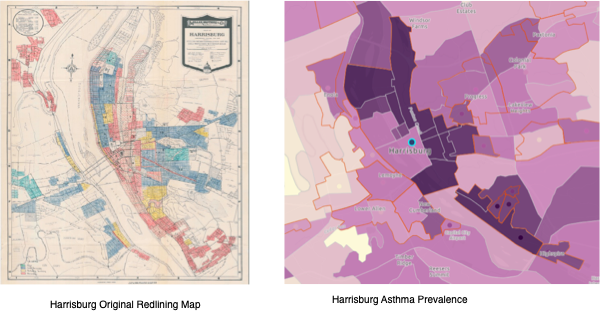
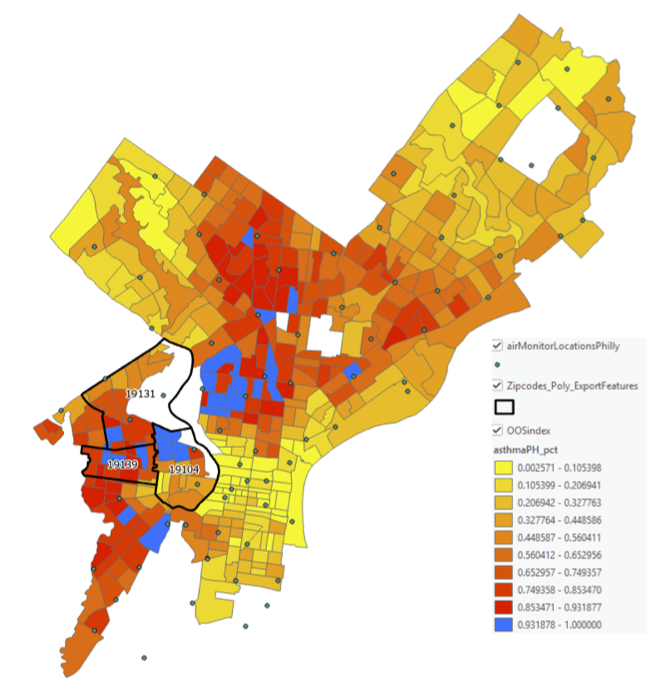
Asthma is a respiratory disease that can occur in children and adults and persistent in redlined cities. Sometimes bronchitis episodes can lead to asthma in children. Breathing can be difficult for those with asthma, especially in polluted areas, because airways are restricted by particulate matter, especially PM2.5. The environment is an added form of health injustice, as those already carrying the burden of economic, social, and health disparities have the highest asthma prevalence. It means more missed school for kids, missed work for adults, and more visits to the ER and doctor’s office. West Philly and Harrisburg sit at the top of the Asthma prevalence mountain (see figures). In ZIP code 19104, PA EnviroScreen reports asthma prevalence for adults over 18 at 14-15%, which ranks some parts of this neighborhood in the 95-100% percentile in the state. I wonder what the percentile is for children?
Caption: HOLC redline map for Philly (mid-1930s) and Asthma Prevalence in Blue Circle Areas (D20)Caption: HOLC redline map for Harrisburg (mid-1930s) and Asthma Prevalence
Monitoring the air quality in Philly and Harrisburg
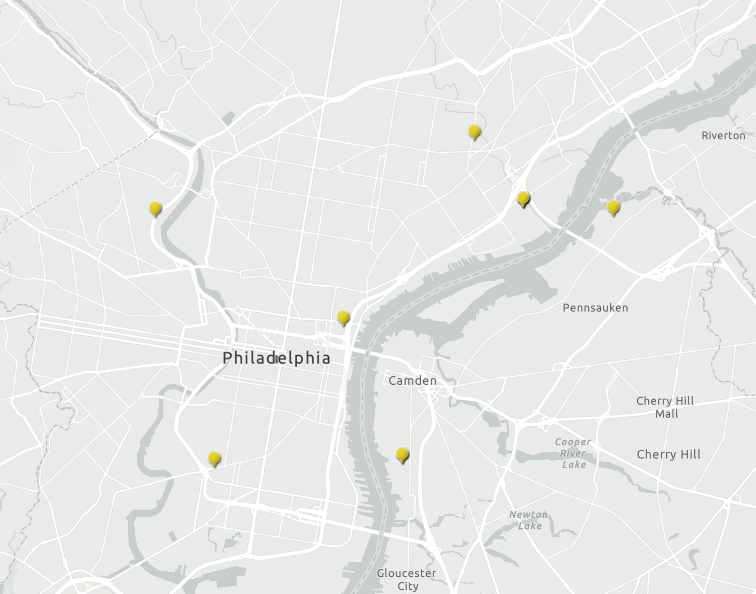
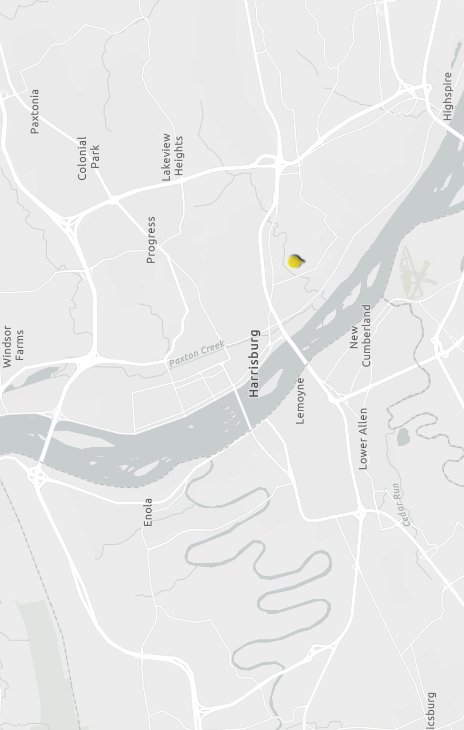
In the past, the Air Management Service had approximately 5-9 reference monitors in the city of Philadelphia but this network could not possibly capture all of the local sources of emissions; however, it did provide a larger-scale view of pollution needed for EPA compliance. The PA department of Environmental Protection (PADEP) has one monitor for city of Harrisburg near the incinterator but it does have lots of truck traffic
EPA reference monitoring stations in Philly (Aug. 26) EPA reference monitoring stations in Harrisburg (Aug 26)
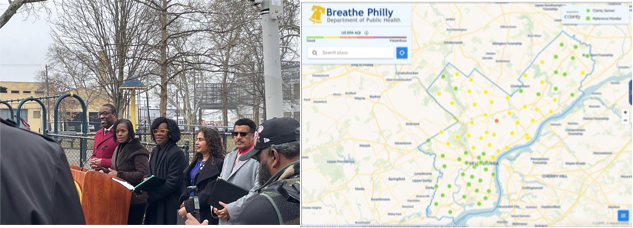
During the month of February, Philly got a big boost for air quality monitoring when the city announced the Breathe Philly project which provide an additional 70+ sites for monitoring PM2.5 and NO2.
Caption: Mayor Cherelle Parker and her team, a map of the Breathe Philly Project Caption: Asthma Indices (higher asthme – blue) and Breathe Philly Network (dots)
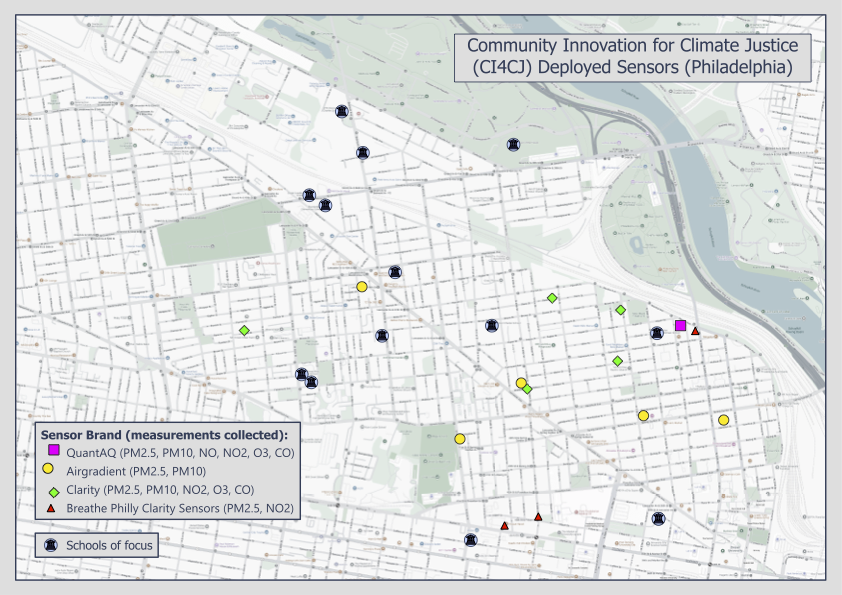
With funding from the EPA through the Green & Healthy Homes Initiative (GHHI)’s Thiving Communities grant, the nonprofit that I founded, Community Innovation for Climate Justice (CI4CJ-ci4cj.org) adds another layer of monitoring in West Philadelphia. We aspire to increase the number of monitors by a factor of 10 across 19104 and parts of 19131 and 19139 (Map) where the highest asthma prevalence is found but not enough air quality monitors. Our goal is to determine if there are hotspots in these zip codes, when they occur during the day and to share this information with the community. We have a team of talented faculty, and students along with the data manager and me to get the work done.
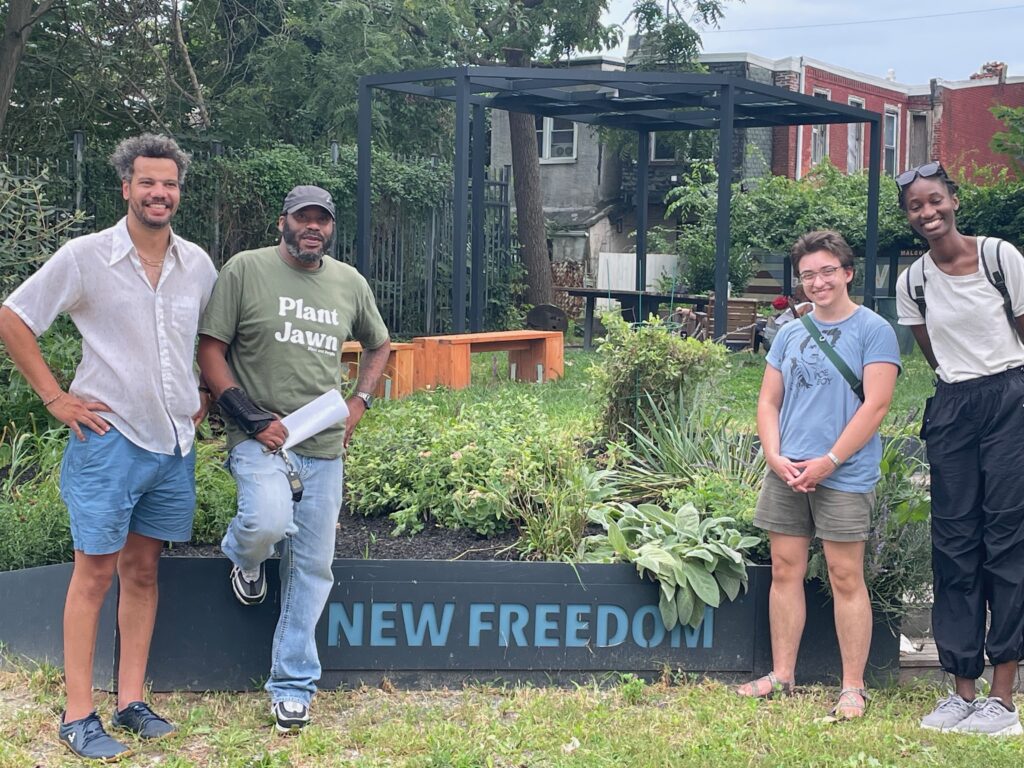
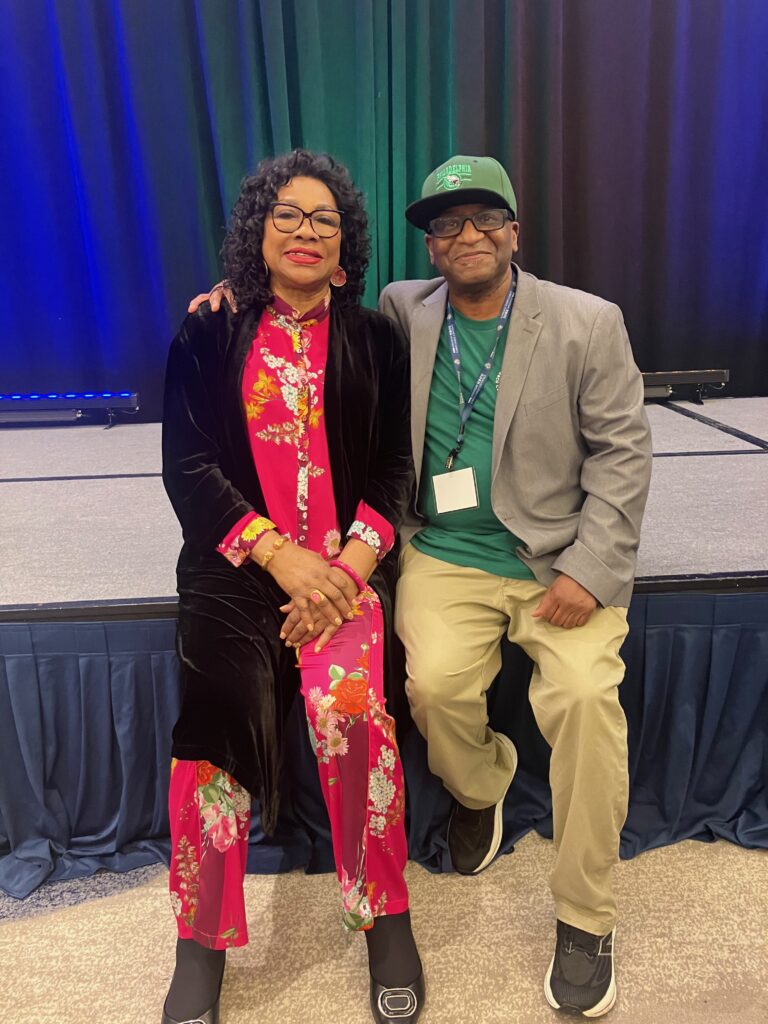
Caption: AQ monitor installment at Lex Garden in Philly with our host (Dante – green shirt) and our research team (Dr. Carryon, Lee and Balkissa). Caption: CI4CJ air quality network that is being developed in West Philly near school locations.
The Big Picture of Climate Justice
Air pollution is only one of the challenges facing redlined areas. The climate crisis poses another threat where redlined neighborhoods will be warmer than non-redlined neighborhoods. Weather extremes in the form of floods and damaging winds are also likely to strike these neighborhoods (recently black communities in Gary Indiana and Memphis TN were without power). We need to develop that capacity to increase weather and pollution measurements in redlined neighborhoods and other vulnerable neighborhoods in cities. To do this, we must work with community groups and individuals to help monitor the environment. Redlined areas in Philly and Harrisburg who have bright young people who can help to protect their families and communities from environmental threats. In addition, they need a safe space to develop their intellectual soft and hard skills for college or the workforce. Finally, our youngest people will see the worst outcomes from climate change as the planet continues to warm rapidly.
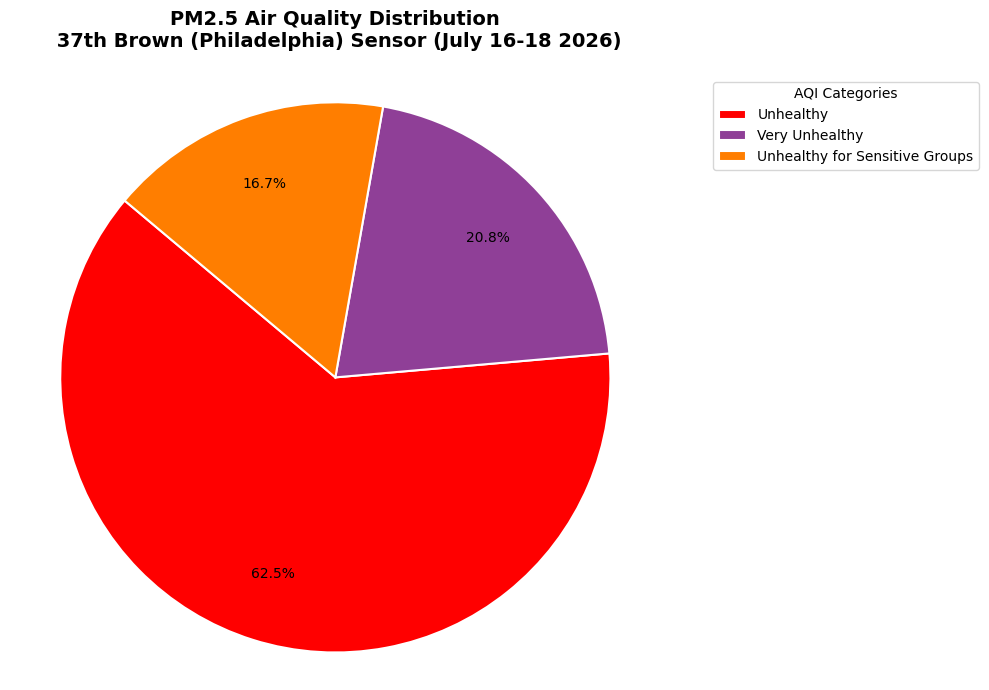
When the threat of heatwaves, extreme weather or wildfires threaten communities our young people need to respond to that challenge. For example, during July 16-18 2026 wildfire smoke event in Philly, the measured air quality in our network was unhealthy for nearly 72 hours.
Because the temperature were near 90 degrees people had to run their air conditions to keep the house cool but unknowingly brought wildfire smoke into their homes. This is because the smoke particulate matter will ge through the typical filter unless you have a Merv 13 filter. The other solution was to have an air purefier while running your air conditioner. I went to a program at the Mantua Civic Association in West Philly there a monitor is currently being housed. Environmental Justice champion and councilwoman Jamie Gauthier was the keynote speaker for the young students (8-13).
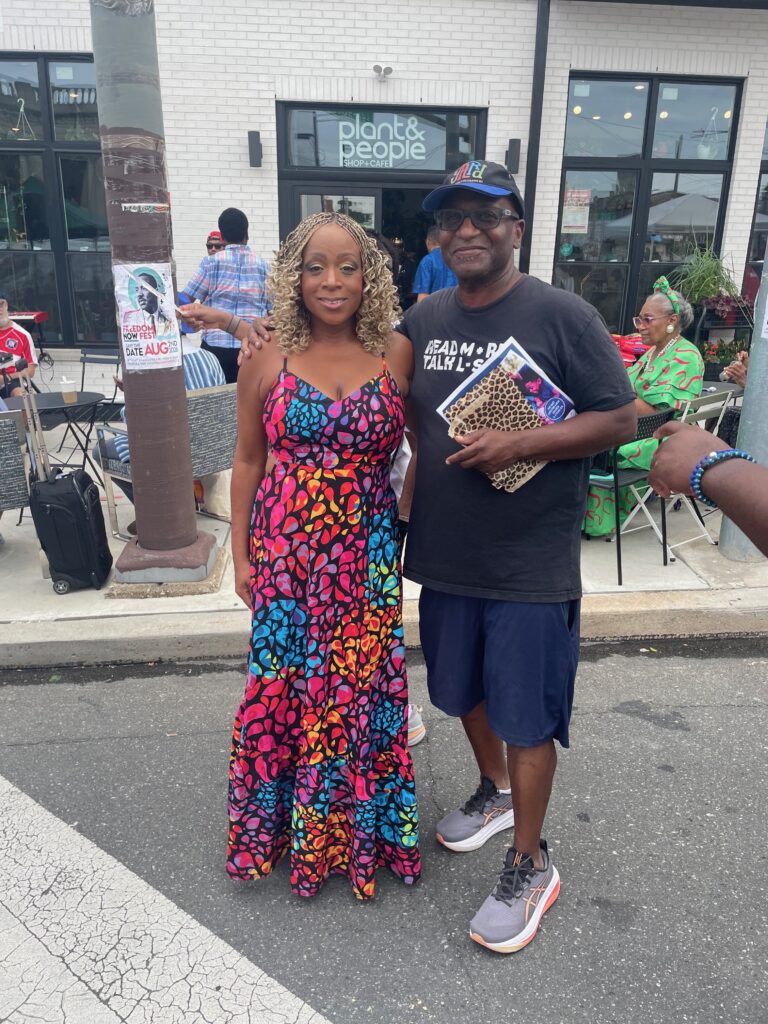
Caption: Percentage of for air quality categories for the 72 hour period of July 16-18– based on PM2.5 concentrations.Caption: Councilwoman Jamie Gauthier and me…. at the Lancaster ave fest.
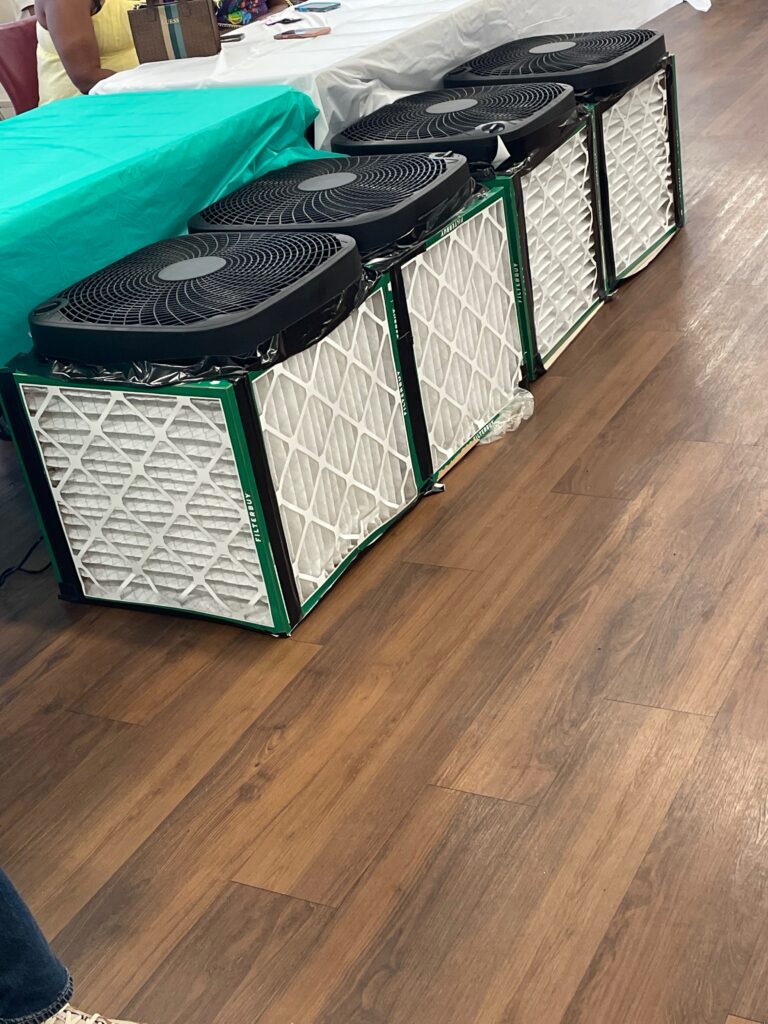
Given the poor air quality conditions, the students developed an air purifier that could be used during wildfires. This is just one of the solutions that we need our young people to develop to create resilient neighborhods. We are behind the curve on addressing climate change, and the only way for us to limit future climate injustice is through community action. Ready and willing Let’s go!!
Caption: West Philly student designed air purfiers to address indoor wildfire smoke
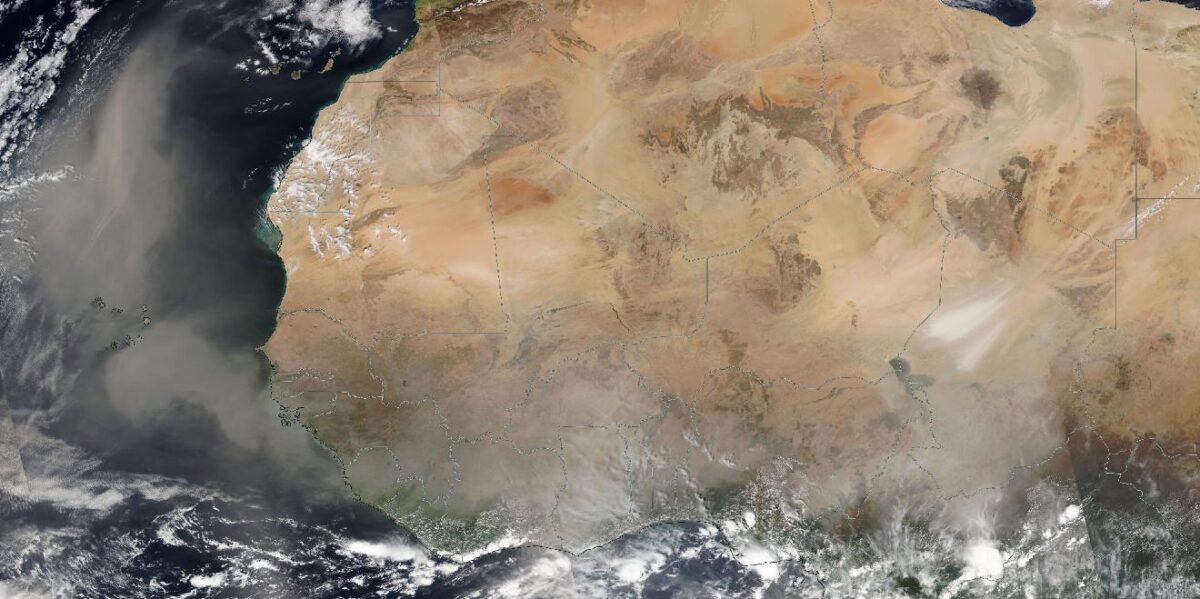
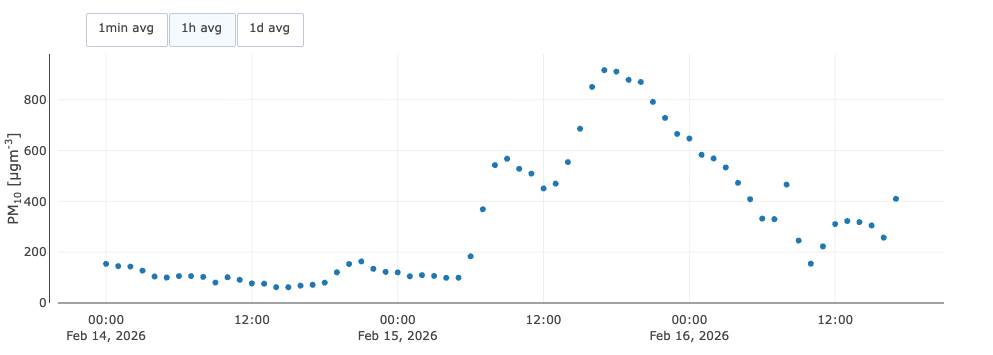
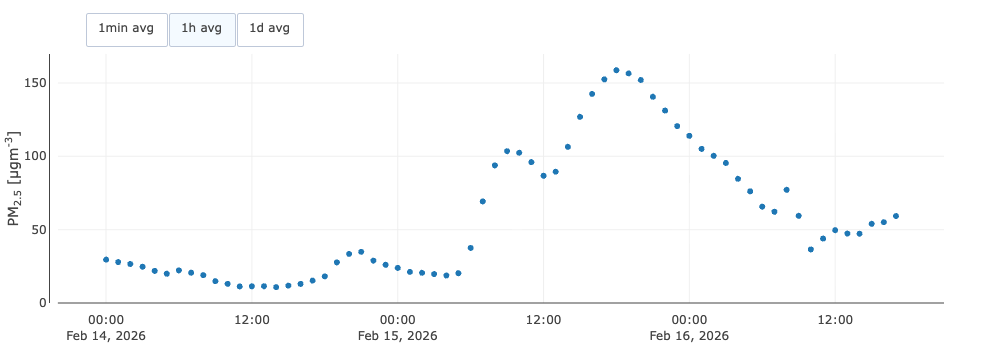
A series of high-pressure systems moved from the Atlantic across North Africa, and the Sahara Desert started last Sunday. The movement of high pressure has increased surface winds, leading to sand blasting and dust lifting. PM10 and PM2.5 Dust concentrations exceeded unhealthy levels in Cabo Verde with PM10 reaching 500 micrograms/m3 and 50 PM2.5 micrograms/m3 on early Sunday Morning. Later in the afternoon, the PM10 values continued to rise with values exceeding 800 micrograms/m3
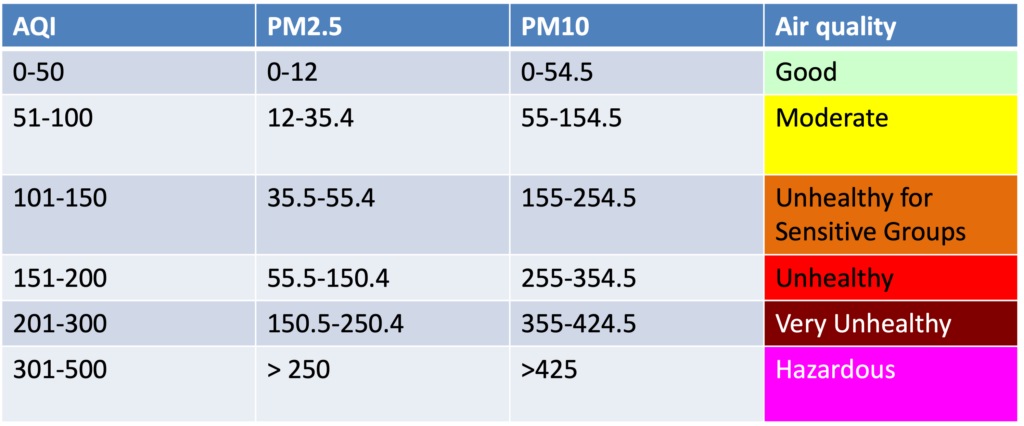
US EPA air quality with the Air Quality Index (AQI) and PM2.5 and PM10 concentrationsPM10 concentrations Saturday, Feb 15, through Monday, Feb 16 at Praia Cabo Verde PM2.5 concentrations Saturday, Feb 15, through Monday, Feb 16 at Praia Cabo Verde
On Monday, as the dust continued to move from the desert, Dakar Senegal reported PM10 concentrations exceeding 1000 micrograms/m3, and PM2.5 concentrations exceeded 300 micrograms/m3.
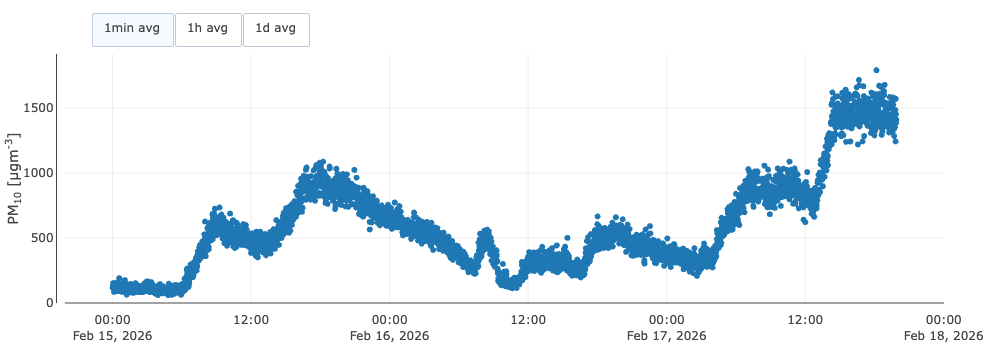
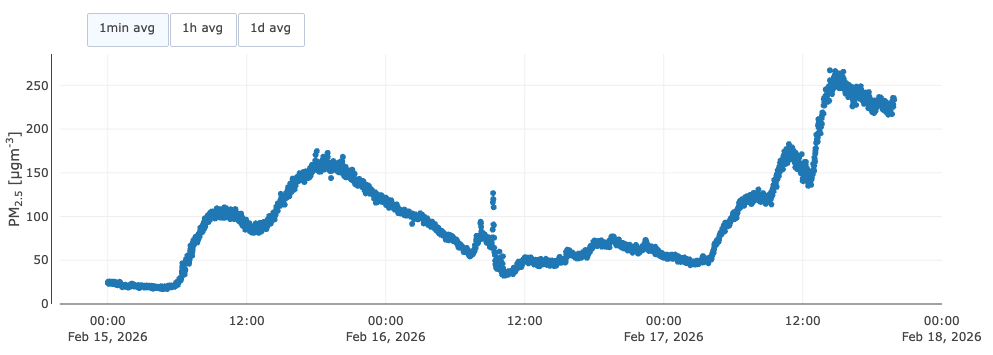
In the last few hours, the PM10 has exceeded 1500micrograms/m3, and PM2.5 250!!! Both of these levels are considered hazardous, and anyone with respiratory or cardiovascular issues is at heightened risk. These levels suggest that people must stay indoors until dust levels come down.
PM10 concentrations through Tuesday Feb 17th at Praia Cabo Verde PM2.5 concentrations through Tuesday, Feb 17th at Praia Cabo Verde
Future Dust (This week)
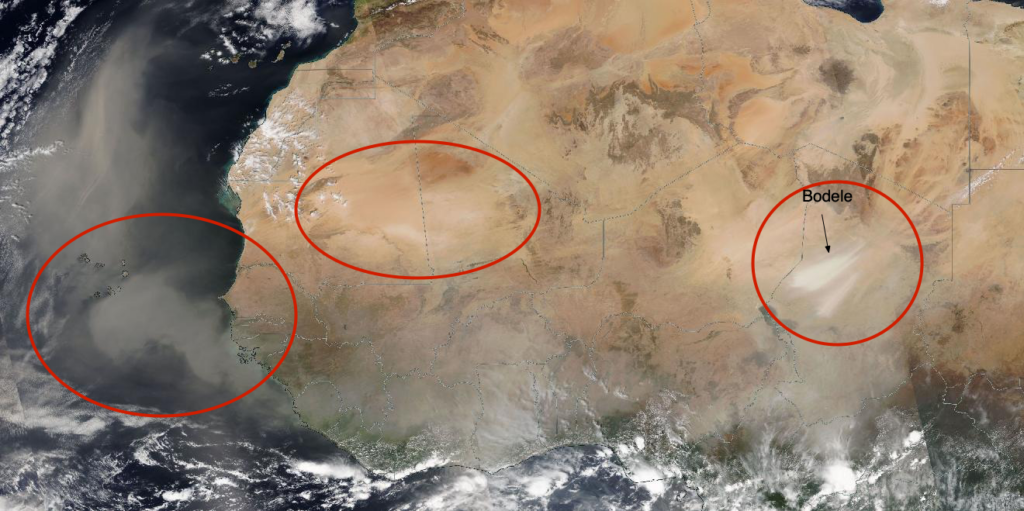
The area of high pressure has moved eastward and is not exciting dust over the Bodele Depression — the largest dust emission source in the world.
Dust Locations on Tuesday afternoon in Red
The dust from Bodele will move across the entire Guinea region over the next few days. This includes Nigeria, Niger, Ghana, Togo, Benin, Burkina Faso, Ivory Coast.
WRFModeled forecast of PM10 from February 16 through February 26.
There does not appear to be much relief for West Africa from high dust concentrations over the next week. The WRF movie of PM10 concentrations depicts little relief for most of West Africa in the coming days.
Serious Health Concerns to Vulnerable Populations
Because PM10 and PM2.5 are expected to remain at unhealthy to hazardous levels, there is an increased risk for lower and upper respiratory health impacts.
First, limit your time outdoors until these dust events pass.
If you know people who have asthma or other cardiovascular disease please check in on them.
If you have air conditioning and can close your windows, please do so. The nighttime PM values will be high because particulate matter is trapped at night.
Watch out for the kids and the elderly during these events.
If you feel like someone is going into acute respiratory stress, please take them to the emergency room.
Pay attention to your local news and ministry of Environment.
To say that the last few months have been normal would be the understatement of the century. On one hand, things seem to be business as usual (BAU), with people going about their lives, planning summer vacations, and already getting ready to send their children back to school. The stock market is at an all-time high, blockbuster movies have come and gone, and people are getting ready for college/NFL football season.
But the reality is that it is far from normal. President Trump began his assault on immigration, climate change, environmental justice, and DEI from day 1 of his term. Many of his executive orders have been challenged in court, but at this point, they are only temporary stays, and more executive orders or statements from the Department of Justice have pushed the limits on executive power. No one was quite sure if Trump’s statements from his campaign would hold any water, but we now witnessed the full power of the government (executive, judicial, and legislative branches) working against ordinary citizens, law firms, universities, government agencies, foreign governments, and the US Constitution. In addition, wars in Gaza, Sudan, the DRC and Ukraine have taken the lives of many innocent victims (more below), and this has led to my despair.
A few months ago, I felt that there was enough power to fight and resist many of the daily salvos from the Trump administration. However, as time went on, the daily news became overbearing, and I often thought of completely shutting out the news. But I know that information is power at the end of the day. Even so, watching the news has left me unable to clearly express my thoughts in blogs (2 blogs were lost) or peer-reviewed journal articles. The friction of what is happening has been slowing down or shutting down my productivity.
Gaza and the starvation/genocide of 2 million people are very hard to face every day. Only recently has the main media talked about the food and other life essential items being shut off, along with missile and drone attacks that have impacted and killed many innocent people. I listen to democracy now in the morning, and it gives me a realistic view of what is happening on the ground in Gaza. I remember the day Hamas attacked Israel, and I spoke to my class about the injustice and brutality of the attack. After nearly 2 years, I don’t feel that Israel is justified in the resulting actions of killing more than 60,000 people, destroying nearly every single building, school, hospital, and starving 2 million people. The West Bank also has too much violence by settlers, which the government approves. The ultimate violence is the goal of annexing and displacing the entire Palestinian population.
Closer to home, universities have had their budgets reduced because of the changing priorities of the Trump administration. They have been playing bully ball by using student protests and DEI as reasons to stop funding research at public/private universities. They have also forced multi-million dollar settlements with universities paying the government. Some areas of research, such as climate change, environmental justice, and important medical and social research about minoritized persons, have been terminated. Many colleagues have retired, climate monitoring on the ground or by satellites habe been cut, and many websites are gone.
International students carry the fear of having their visas revoked and being sent home without the degree that they came to obtain. Those who have protested against the violence against Palestinians have been arrested, kicked out of school, and in some cases had their degrees expunged. We are now in the phase where student visas are revoked for petty incidents such as traffic tickets or DUIs.
Immigration policies have led to the disappearance of many innocent people who may have been fleeing violence in their own countries. Now they are stereotyped as violent, job-stealing, illegal immigrants who are making America weaker. We know that this is not true, because much of the food we eat, the roads we drive on and the nursing homes that our loved ones are at are handled on a daily basis by humans (immigrants) waiting to become citizens in the United States. The violence against our immigrant population has only expanded with the president using his executive powers to bring the National Guard and Marines into cities to support ICE arrests. In recent days, the president has used the National Guard to control Washington, DC, especially in black and brown neighborhood,s while also supporting ICE arrests.
I am not sure how a person paying attention could do BAU without going insane or becoming depressed at some point. While I have attended marches, it hasn’t had the effect of removing the despair that I feel. However, over the last 6 months, there have been individual leaders of light who have provided glimmers of hope for turning despair into action. I am going to call them out, but plan to write another blog about them.
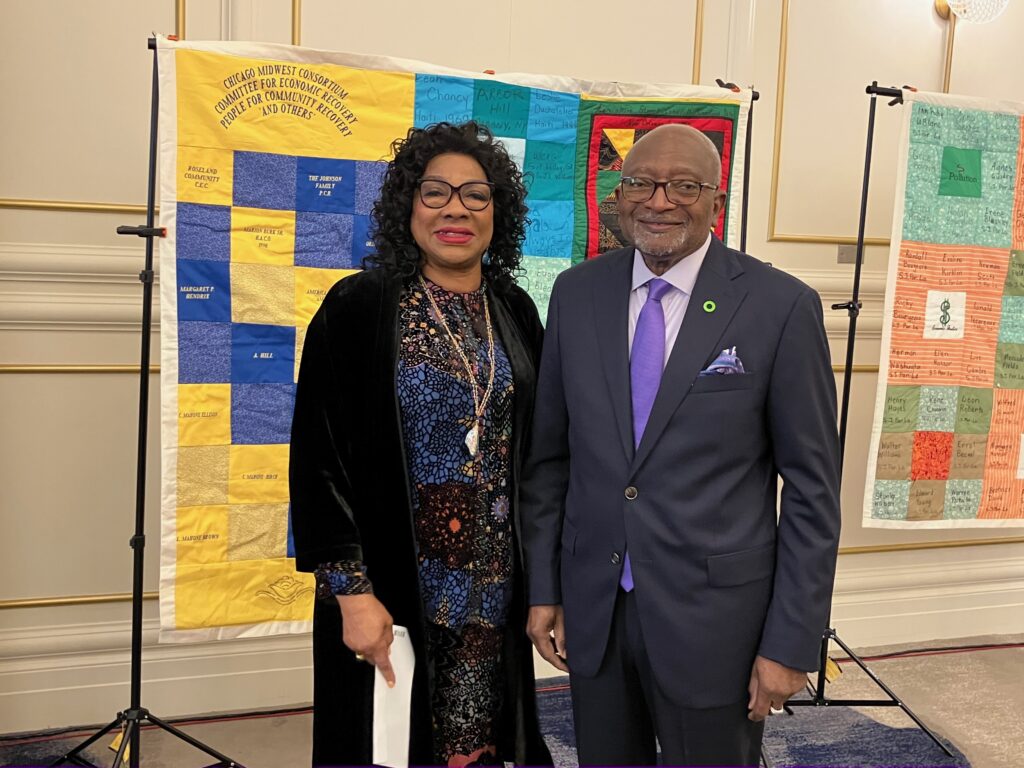
Dr. Beverly Wright. Environmental Justice leader and Director of the Deep South Center for Environmental Justice. She and Dr. Bullard have built and anchored the HBCU climate change consortium meetings. More importantly, she has been supportive of communities that have faced environmental injustice over the last four or more decades. A true soul-sister.
Dr. Beverly Wright Drs. Wright and Bullard (the dynamic duo).
Bernice Miller-Travis – a force and co-author with Charles Lee on the 1987 United Church of Christ report on toxic waste and race. She is part of the Metropolitan group in the DMV. She is soooo bright, filled with wisdom and insight.
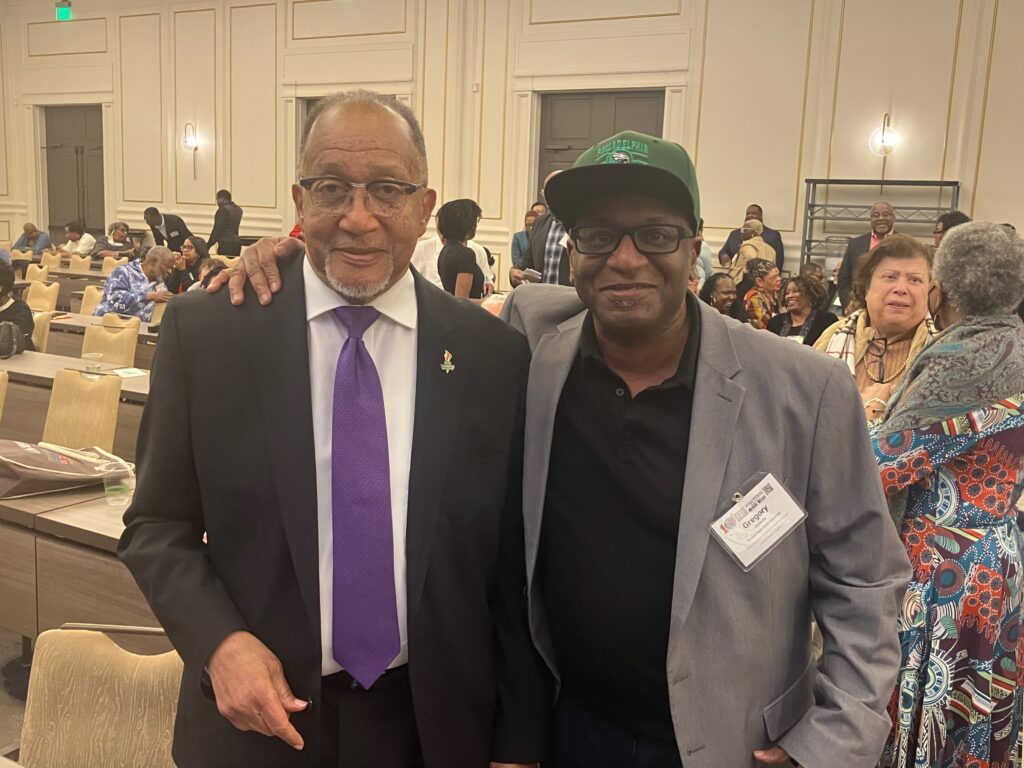
Dr. Benjamin Chavis Jr. – At the forefront of the Environmental Justice movement in the 1982 Warren County protest, which kicked off the EJ movement. His spoken words of “Black women being at the front of the EJ movement” and ” the completion of his Master’s degree in Prison” stay with me.
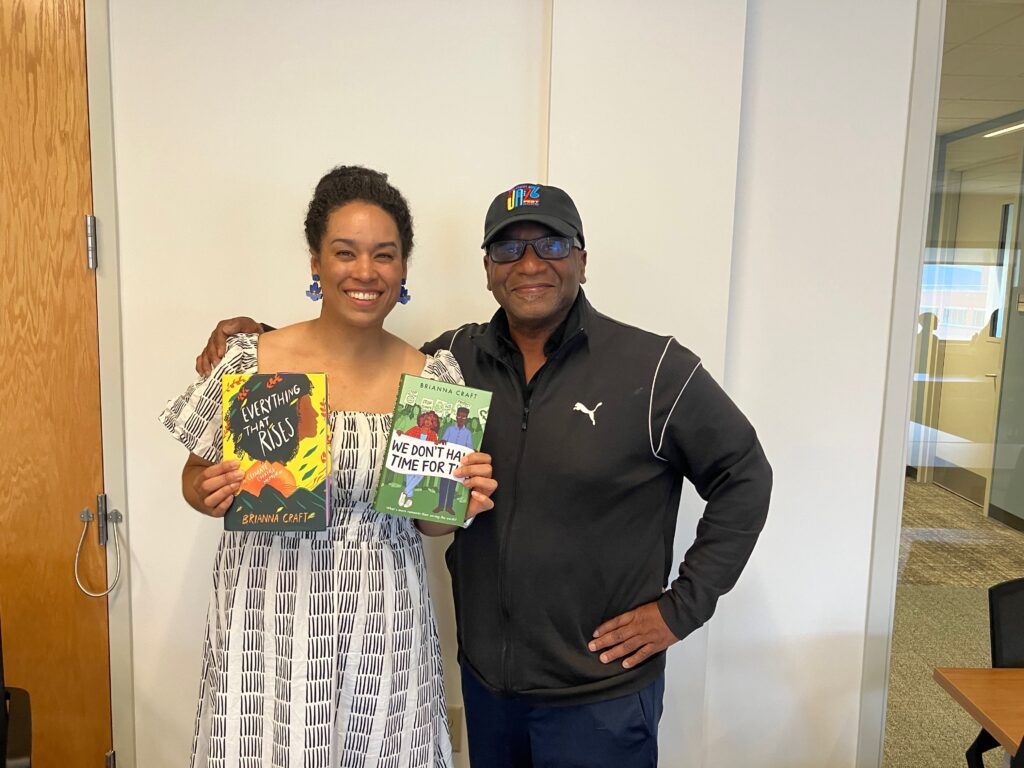
Brianna Craft – Climate Justice leader and author of “Everything that Rises” and “We don’t have time for this.” She breaks down the ingredients leading up to the Paris Agreement and key issues of climate justice in novel form.
Lakecia Benjamin (The Phoenix) – unbelievable jazz Musician and beautiful spirit. Her last album, Phoenix Reimagined, brings her ancestral energy to the forefront.
Calvin Macke – Founder of STEM NOLA. I am always motivated by his sheer will to fight on and innovate for the community.
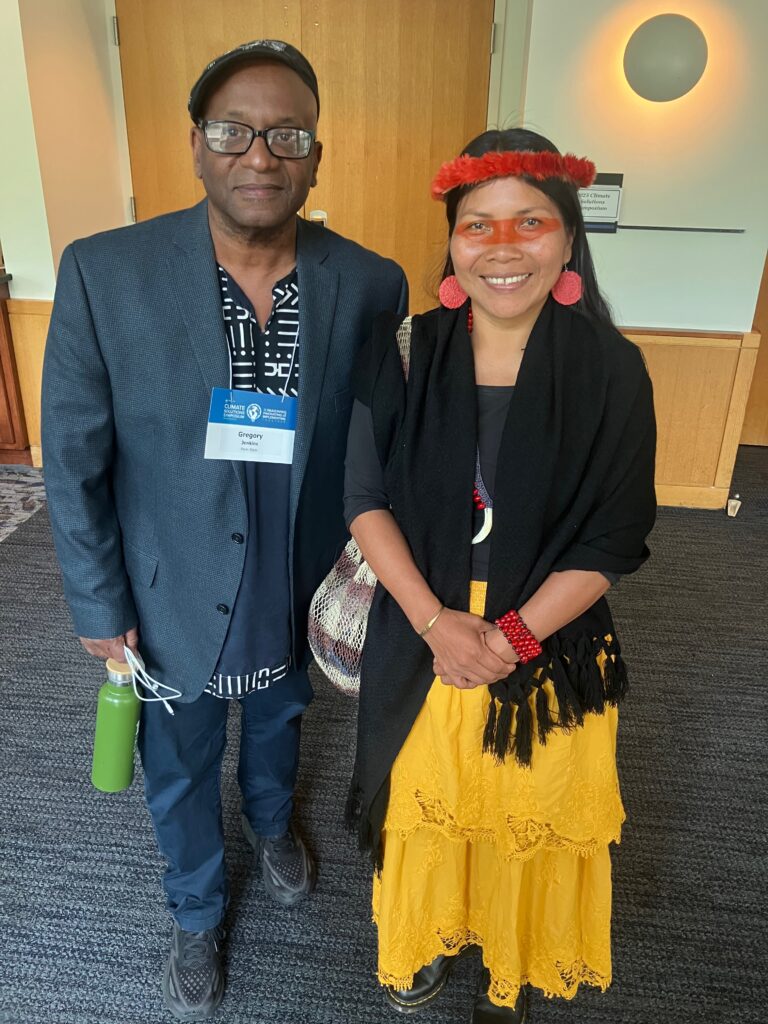
Nemonte Nenquimo- Leader of the Worwani Nation and Climate Justice Warrior from Ecuador. She guided my spirit work by getting me to spend time in nature and my garden this summer. Author of we will be Jaguars.
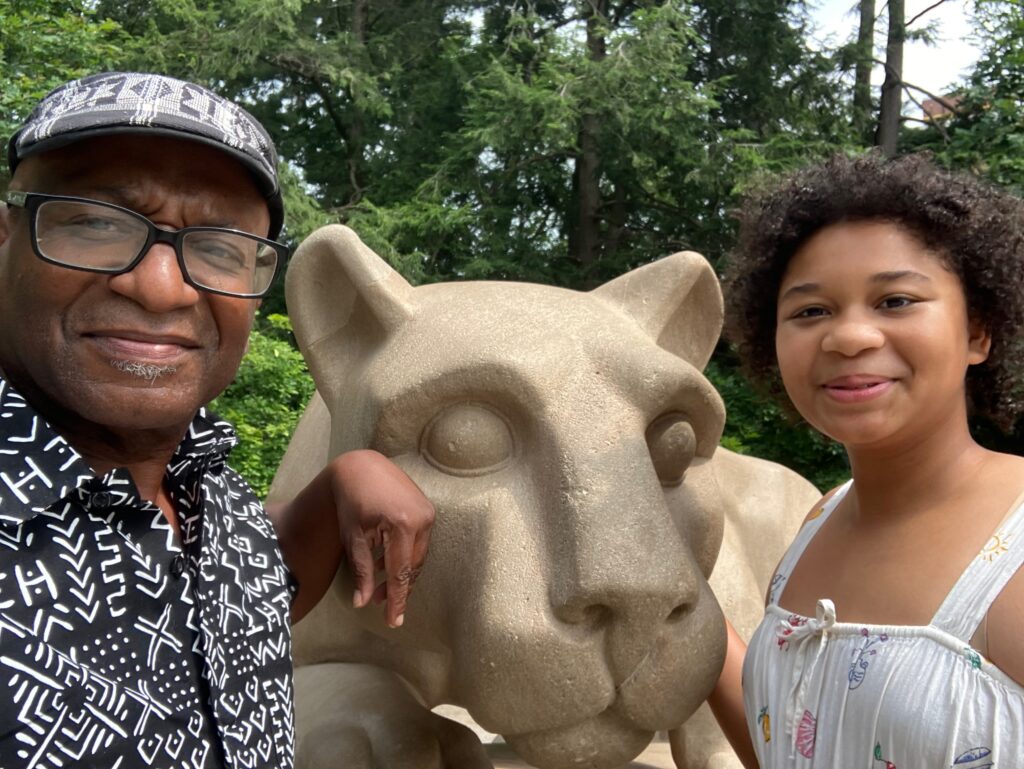
Zoe Wooten – My granddaughter, who will live through the climate crisis. She often hears my rants about climate injustice, but I predict that she will care deeply about climate justice.
While I still feel the residue of all flying darts from the current administration, that is not a reason for despair and losing hope, but a time to find Active Hope. Joanna Macy (she recently transitioned) and Chris Jonstone have written a good book on about this – Active Hope: How to face the Mess we’re in with Unexpected Resilience and Creative Power
Much of what this blog is about is what book Active Hope outlines- The Great Upheaval, Business as Usual, and the Great Turning. The Great Upheaval involves climate change, social injustice, the pandemic and the policies of the current administrations. Business as Usual is, in fact, driving some of the Great Upheaval, but it is a mindset that many of us have taken in this time. We choose to look away or not talk about the Great Upheaval happening right now because we feel helpless. People involved in the Great Turning know that action is necessary which, includes unifying people across space, class, religion and other differences. It also lifts us out of despair and turns us toward Active Hope. I hope that writing blogs will remove any lingering despair and replace it with positive thoughts.
Since January 20th, the MLK National holiday, we have been forced to address the threats to civil and gender rights, federal jobs, and environmental and climate justice, and we have witnessed the snatching of people who are deported. Federal grants have been threatened, and some agencies, such as NIH and NSF, have been frozen. The Trump administration has effectively closed USAID and plans to do the same to the Department of Education without congressional approval. He has given many federal employees until Thursday, February 6th, to take a shaky buyout. He has threatened to cut the workforce in NOAA and NSF and has been witch-hunting many who appear to be doing work with DEI. Today, he effectively closed the EPA’s Environmental Justice Office. These impacts will manifest as injustices on communities of color; sooner rather than later.
Much of what is occurring has never been seen (except in Octavia Butler – Parable of the Sower), and many cases are pending in court to confront the power grab.
But let’s be clear that this is black history month – “present is past” and “past is present.” We are here because of our ancestors and we limit today’s mistakes through the lens of history.
Thank God and the ancestors that the living legacy of Civil Rights and Black History is alive today through the strong and ethical voice of Attorney Letitia James who has challenged Trump’s and DOGE’s authority more than once and she is on the job protecting all of us.
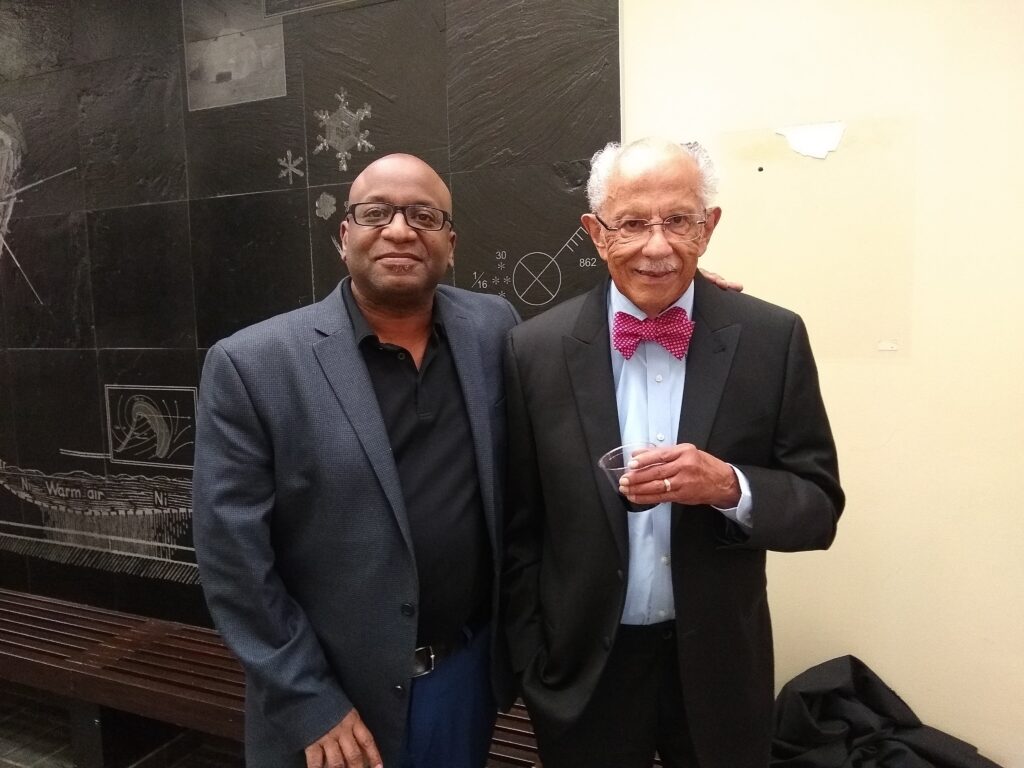
Two weeks ago, I gave a seminar to the Department of Meteorology on the Legacy of Dr. Warren M Washington. Check out my 30-minute Black History Month contribution to yall about Dr. Washington!!
Today, times are different because we have mobility and probably make more money than our ancestors, but we have more debt, more stress and our sense of community is scattered. If I asked you the question– who is our national black or brown leader– who would you say? I might also ask if we need a leader? Can’t the masses challenge this system? I think it can, but a sense of moral direction from a voice like Malcolm, Martin, Coretta Scott King, or Dr. Beverly Wright can sometimes help keep us aligned or focused on injustice.
Pioneers such as Warren and many others are celebrated because Dr. Carter G. Woodson created Black History Week, which is now Black History Month. It means that no matter the current threats, we lean on the wisdom, courage, and fighting spirit of our wise ancestors who made the way for us. It’s not just the famous people, but it’s your grandparents and great-grandparents who made history by making today possible through creativity, love, courage, fighting, and preserving against violence, hate, lack of opportunity, and even enslavement.
We must find the voice within to carry us–right now, and if that voice is scared…. reach out to an ancestral voice (Malcolm, your fearless grandmother, aunt, uncle, or great-great grandmother/father). Let them guide you in this perceived world of threats. We face intergenerational traumas of the past that live in our bodies, but we also have intergenerational strength from the past.
That is indeed what black history month is. Remember them and find your way back to your authentic power.
Even if we are afraid, we must protect the future, which will face an even more significant threat if we look away now. Please don’t. Fight on today– for the future and honor those who threw up their hands in the past.
In closing, Dr. Warren Washington helped nurture and manifest the beautyful ones in atmospheric sciences/meteorology (the house of life) that protect everyone from floods, heatwaves, hurricanes, wildfires, tornadoes, and all of the disasters now and throughout the Climate Crisis. May he and all of the ancestors help us to protect our communities.
Music by Lakecia Benjamin (in the tradition of John Coltrane)
Happy Black History Month!!! Fight on people– Float like a butterfly, Sting like a bee.
Follow the words of Earth,Wind and Fire + Maysa
“People, be all you can – but now we need faith in our lives to understand”
Keep your head to the sky – the clouds will tell you why!
Over the last year, we have crossed the global mean threshold of 1.5C as a limit set by the Paris Agreement to limit dangerous climate change. The science has been very clear and there is no uncertainty — we must cut greenhouse gas emissions (CO2, Methane, N2O) in order to limit the warming and protect future generations. We have put more than one Trillion tons of CO2 in the atmosphere since the 18th century which can only accumulate in the atmosphere because its lifetime exceeds those of humans (100-300 years).
Presidential candidate Trump does not want to pursue this pathway because his focus is on the present, so we should expect accelerating CO2 emissions from the US. Presidential candidate Harris has been working to reduce CO2 emissions, but there has been a mixed message about the present and future emissions, in part because of political pressure and past practices. If VP Harris wants to address the climate crisis, there will have to be less stress on fossil fuel jobs, such as fracking and on-shore/off-shore gas/oil and put more focus on the creation of jobs from the renewables markets. When people think about oil production, what comes to mind is OPEC and Saudi Arabia. But, the US is now the largest producer of oil making it a significant greenhouse gas contributor.
Increase in Crude Oil output from the US. Source Washington Post.
Furthermore, the number of permits, for drilling has increased under the Biden administration. We know that if Presidential candidate Trump wins, this will only accelerate over time as he wants to get “liquid gold”, which is really “liquid poison” to many communities and future generations, out of the ground.
From the perspective of young people and those not yet born, what is happening seems confusing and has hypocrisy written all over it. The foundation of the issue is the “tyranny of the contemporary”, where we worry about today’s issues only: inflation, interest rates, employment, jobs reports, savings, credit scores, when can I take my next vacation, and how can I live my best life now. We are essentially discounting the lives of those in the global south, poor communities, people of color, the youngest people on the planet today, and those not yet born, including our grandchildren who will face the worst of climate change.
Yet, we have tools informing us (policymakers) on what we need to do in order to limit the climate crisis, to limit tipping points and to protect those who will be here after we are gone. Scholar and scientist Dr. Warren M. Washington, who passed away on October 18, 2024 https://www.fairmountfuneralhome.com/obituaries/Warren-Washington?obId=33523184 was one of those unique individuals who helped to develop the tools that provide us guidance on our actions today. In addition, he helped to foster at least the last two generations of black and brown atmospheric and climate scientists who are working in universities, government, broadcast meteorology, and private industry.
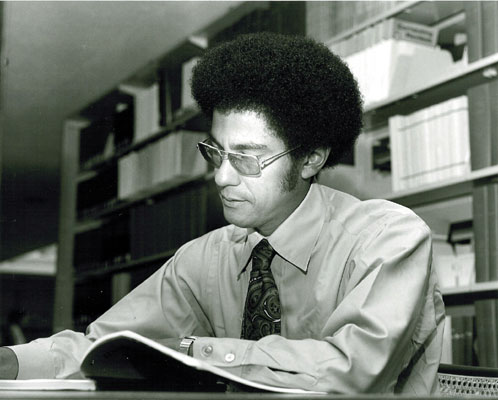
Warren was born in Portland Oregon, and received his PhD from Penn State University (where I currently work) in 1964. He was hired by the National Center for Atmospheric Research (NCAR) in Boulder Colorado, and began to develop NCAR’s first General Circulation Models (GCMs) to simulate the climate of Earth. Within a decade, there were numerous GCMs, including NOAA, NASA and UCLA in the United States and others around the world. This was remarkable, given that the number of black PhD atmospheric scientists in the World could be counted on one hand (Charles Anderson, Godwin Obasi, Warren Washington). Warren went on to be inducted into numerous societies, was the first AMS president, received the National Medal of Science, and advised five US presidents.
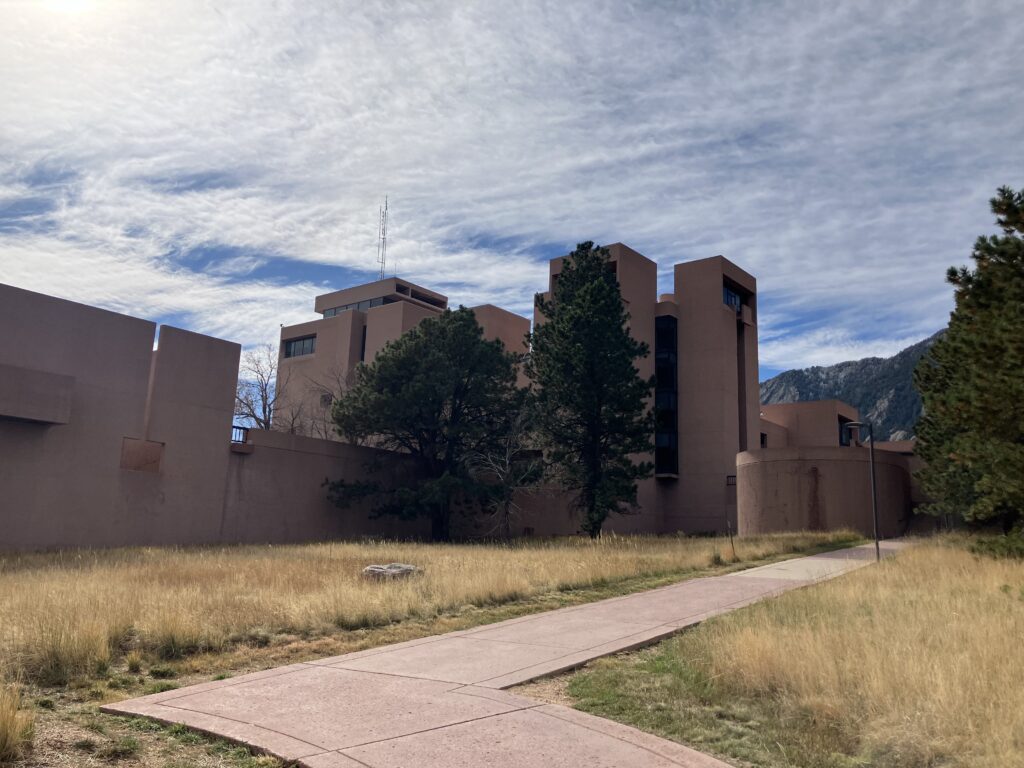
National Center for Atmospheric Research (NCAR), Boulder Colorado
Warren was a master craftsman, always working to include the other components of the climate system – the oceans, sea ice, greenhouse gases and making the model more efficient so that it could be run for longer and in more realistic manners. For example, the original models used only fixed sea surface temperatures to represent the world’s oceans. Warren and his team improved the ocean representation to that of a swamp (water source), then mixed layer (water source and heat capacity), and finally a fully dynamical ocean. There was a similar process that he used for sea ice, which was initially only based on thermodynamic and not linked to the ocean circulation. These advances took several decades, and involved team building across sub-disciplines and the advancement of parallel computing.
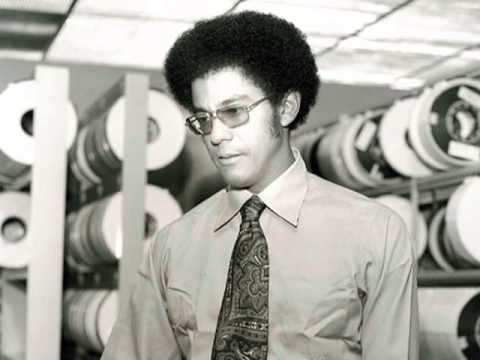
Warren Washington at NCAR, where data from climate models are stored on tape
Here is an excerpt from Warren’s 1986 book which was read at his funeral.
Excerpts from An Introduction to Three-Dimensional Climate Modeling , Warren Washington & Claire L. Parkinson
“For centuries individuals have dreamed of being able to understand how the climate system works and from that understanding being able to forecast and perhaps even modify the future climate. This distant goal has become more approachable as a result of the invention of the modern electronic computer in the mid-twentieth century. With the computer, it is now possible to solve numerically many of the equations encapsulating the physical laws that govern climate. This provides us with exciting new possibilities … Improved understanding of the climate system could have substantial impact on the economic well-being of the nations of the world. …. Therefore, once numerical models reached the stage where the simulations reproduced major features of the atmosphere, oceans, and sea ice, a logical next step was for researchers to begin using the models to simulate conditions other than those existent at the present time, such as paleoclimates or possible future climates affected by increased anthropogenic greenhouse gas amounts and aerosols. … Numerical simulations should continue to increase our understanding of the Earth’s climate system and provide insight into many factors that may influence climate change. As the models improve, the reliability of their results should increase. The potential benefits for mankind are multifold, as more accurate prediction of future states over both short and long time periods should assist planning decisions in many areas of human activity. One of the real merits of such models is that they allow the quantitative evaluation of possible changes. Mankind will need to make choices about how to respond to climate change, and these choices can be aided by enhanced modeling efforts.”
There are now many clips and recordings of Warren speaking about the state of climate science and climate change that he helped to foster as a scientist, scholar, and voice for black and brown people.
University of Toronto, honorary degree
Why is this a Climate Crisis again?
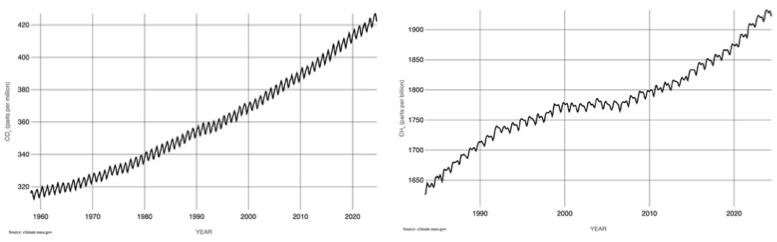
The primary greenhouse gases are Carbon dioxide (CO2), Methane (CH4) and Nitrous oxide (N2O). Both are increasing at alarming rates. When Warren wrote his book, CO2 concentrations were 348 parts per million by volume (ppmv) and today they are 424 ppmv. CH4 concentrations were 1687 part per billion by volume (ppbv) and today 1927 ppbv.
CO2 and CH4 concentrations. (images from NASA)
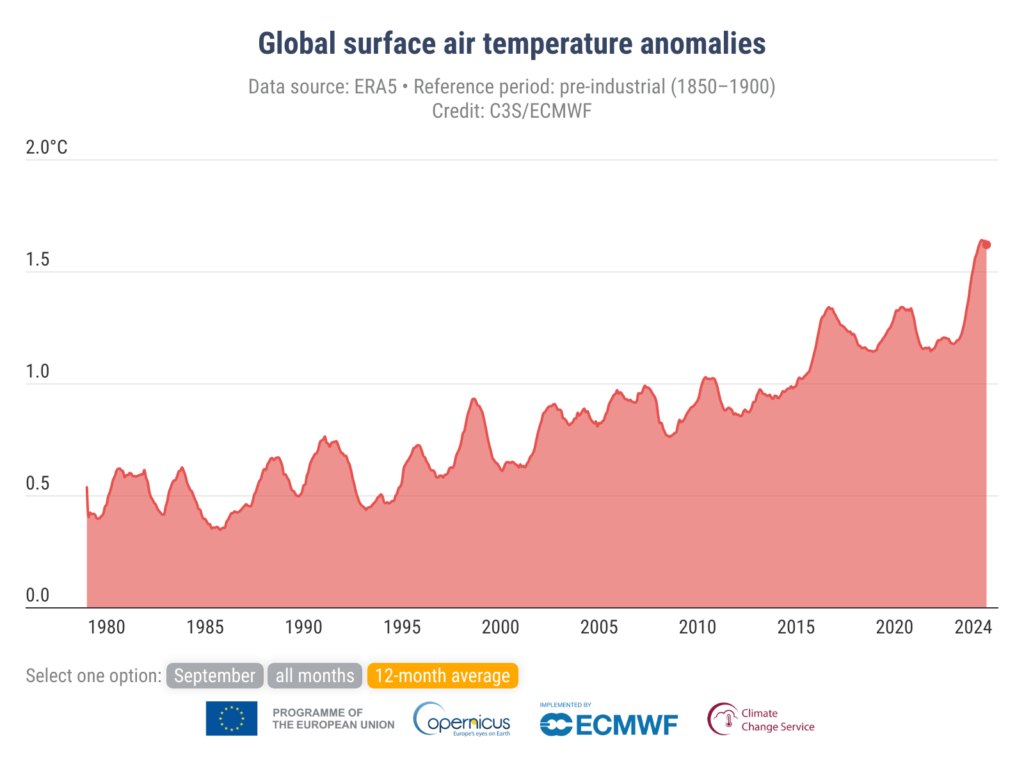
Temperatures over the last 12 months are more than 1.5 C above preindustrial values.
Global Temperature anomalies for since 1980 relative to pre-industrial periods
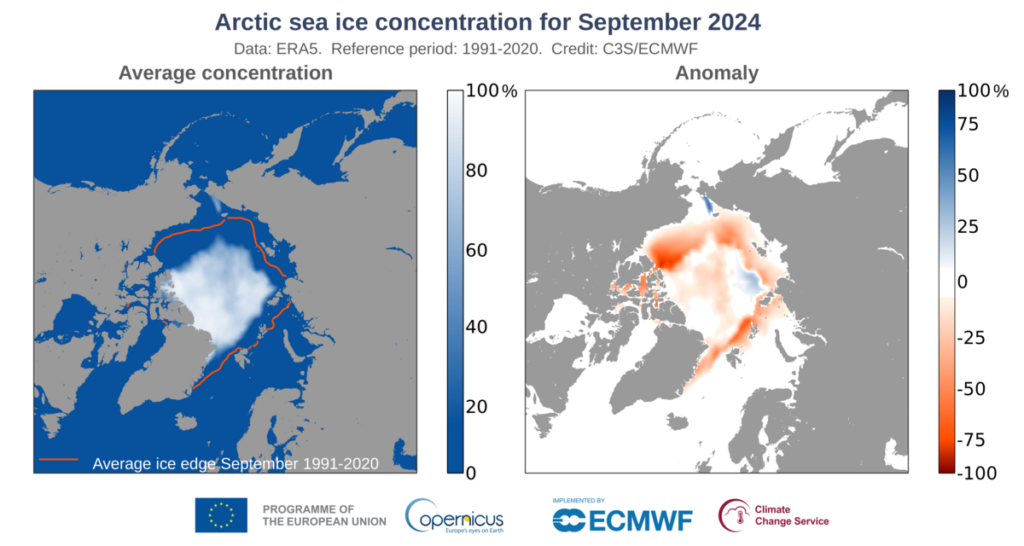
Arctic sea ice which Warren took a real interest in with Claire Parkinson has decreased substantially. It is having a negative effect on the polar ecosystem (life and people).
Changes in Arctic Sea Ice during September 2024. Red line is the 1991-2020 average.
Droughts and Floods
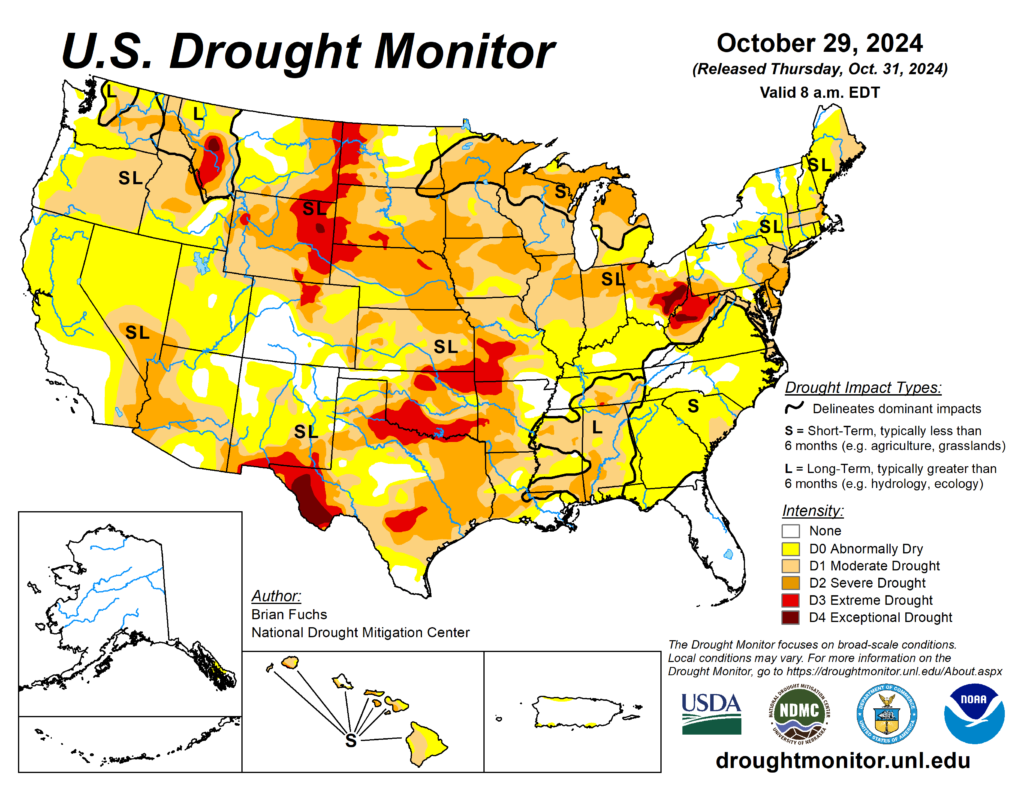
As of the end of October, most of the United States was experiencing some level of drought. The causes remain unclear, but heat domes seem to be related and during this fall, the Jet remains north of its position, with very few weather systems moving from west to east.
US levels of dryness and drought (October 2024).
At the same time, floods have also increased with heavy rain in South and North Carolina this year. In Spain, last week more than 200 people were killed because of floods.
Hurricanes
Two Category 5 storms impacted the United States this year. Hurricane Helene made landfall as a category 5 in Florida, but the greatest devastation and loss of life occurred in Western North Carolina where floods destroyed towns and people are still recovering today.
Destruction of roads in North Carolina (Oct 1) – Washington Post
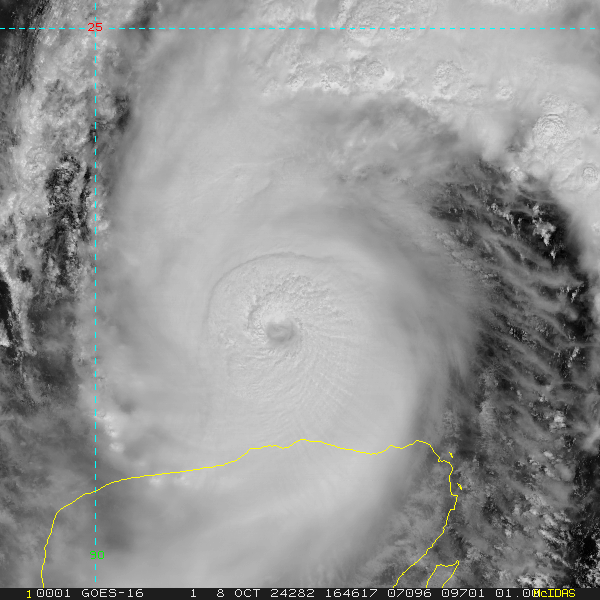
A few weeks later, Hurricane Milton reached sustained wind speeds of 180 MPH while in the Gulf of Mexico but weakened to a Category 2-3 at landfall, sparing many areas from devastating destruction, but many people were still affected by the storm. More than 100 tornadoes were reported in Florida and linked to Milton.
Hurricane Milton north of the Yuctan (Mexico)
The sum of these events should trigger something to the average person – Change has come.
Warren Washington increased the capacity to fight the Climate Crisis
Warren’s mentoring of students of color over the last few decades has significantly changed the field of atmospheric sciences. Warren was the first scientist of color to be the president of the American Meteorological Society (AMS) and now there have been several, including Dr. Marshall Shepherd.
Warren played an important role in fostering many scientists of color in government, academia, research, and industry. From our perspective, Warren was our North Star, guiding us through unknown terrain towards safety in an uncertain field, where we felt isolated most of the time. Because of his mentoring, we survived and eventually thrived. This list includes Dr. Marshall Shepherd (UGA), Dr. Vernon Morris (ASU), Dr. Arlene Laing (CMO), Dr. John Cortinas (NOAA), Dr. Everette Joseph (Director NCAR), Dr. Belay Demoz (UMBC), Dr. Marilyn Raphael (UCLA), Dr. Lesley-Ann Dupigny-Giroux (State Climatologist of Vermont), Dr. Kevin Petty, myself and many others. Through his mentoring, we were able to mentor a second generation of scientists and many are now moving into successful mid-careers.
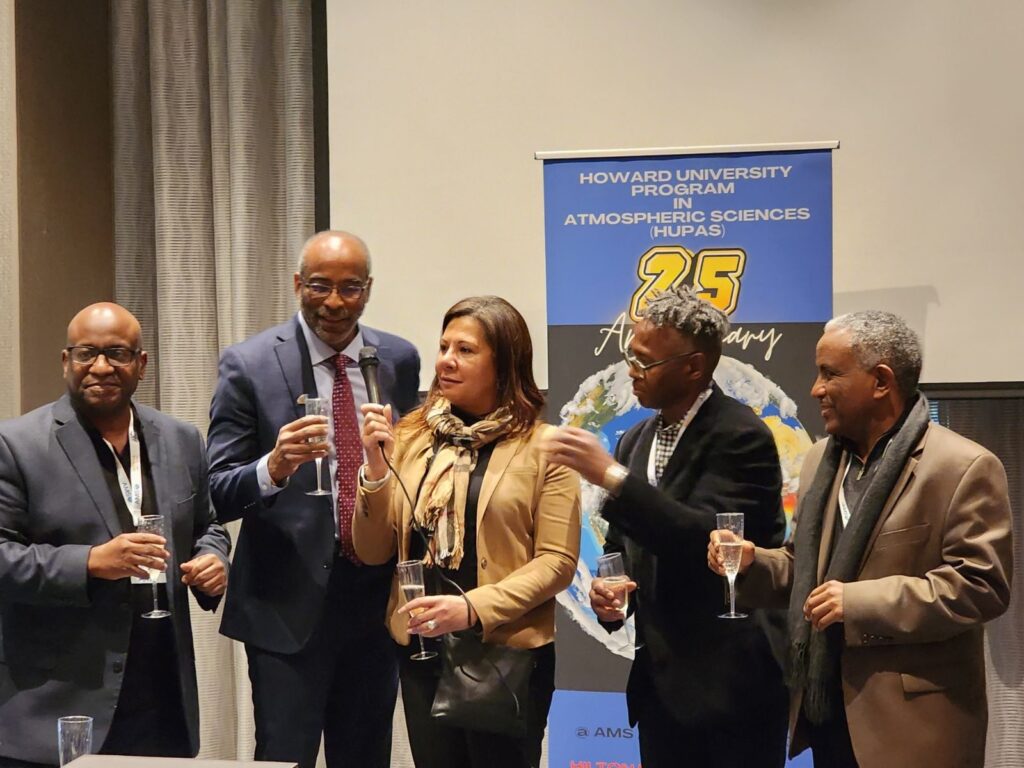
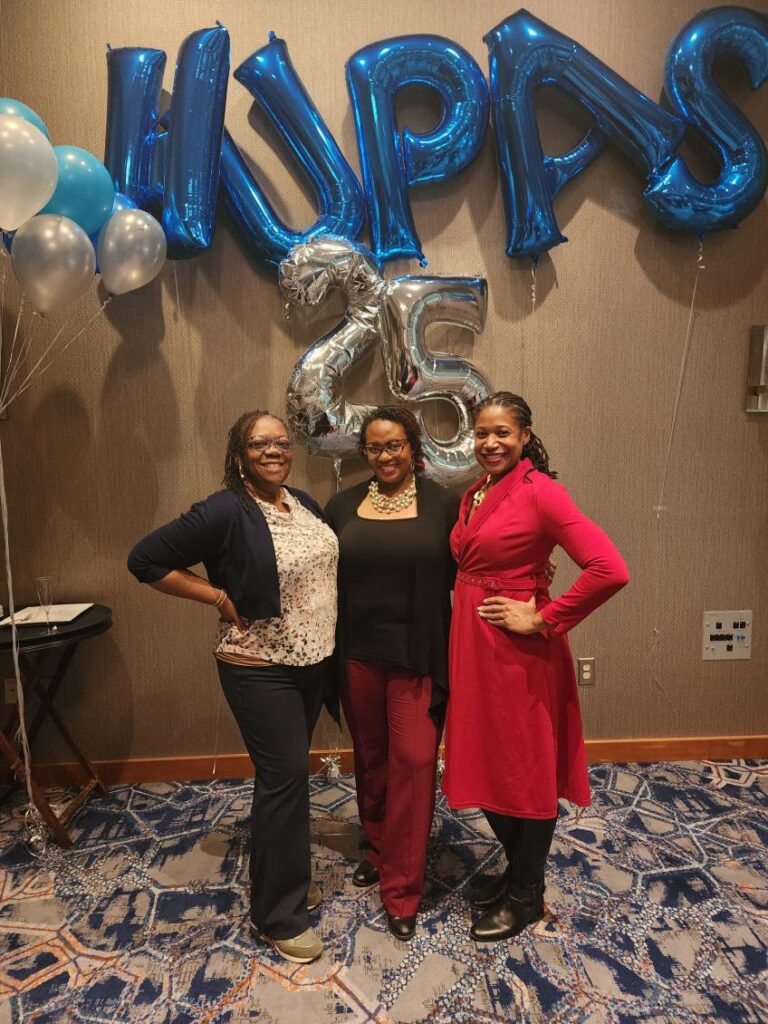
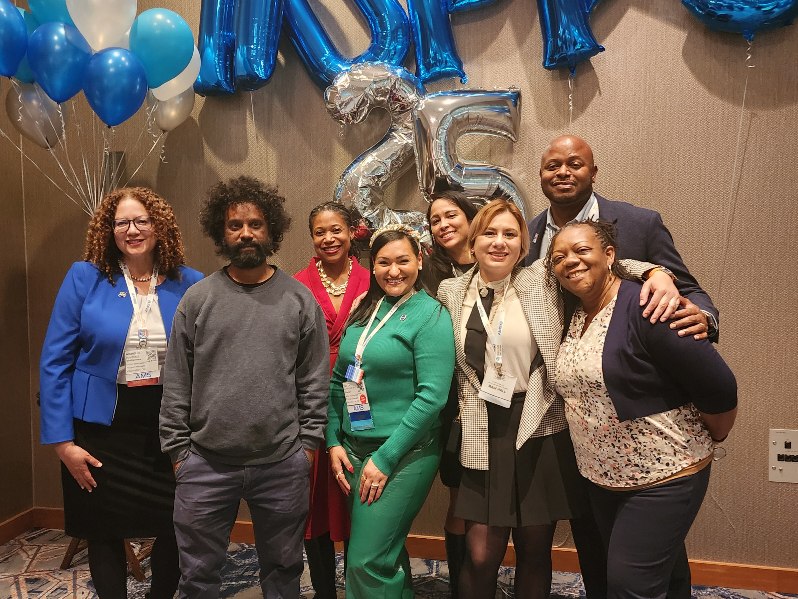
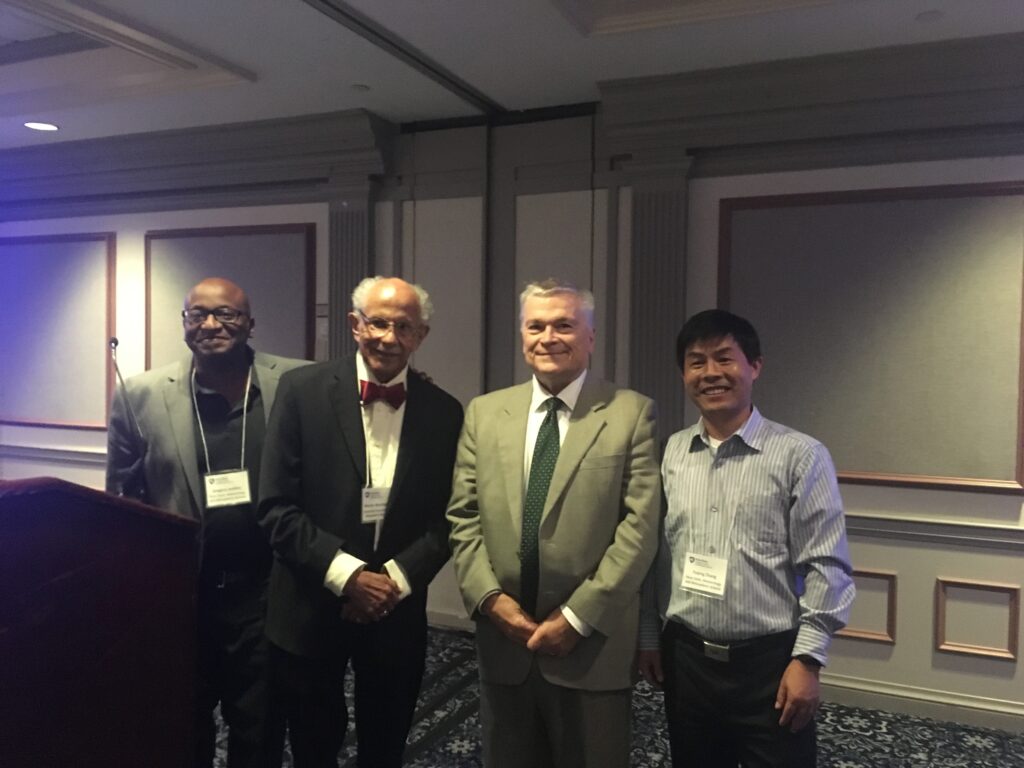
If you watch this video, Warren explains that to increase students of color, academic programs must be deliberate and long-lasting to increase representation in the field. At the undergraduate level, Jackson State University has played that role and at the graduate level, Howard University has played the role. At last, years AMS there was a 25th anniversary for the Howard University Program in Atmospheric Sciences program (HUPAS). The outcome of this program was visible, with many of its graduates working in private, government, and academic settings.
Former HUPAS faculty (Greg Jenkins, Everette Joseph, Vernon Morris and Belay Demoz) and the current HUPAS director, Dr. Sonya SmithHUPAS Alumni (Tamara Battle, Drs Segayle Walford and Jamese Sims)HUPAS Alumni (Dr. Michelle Hawkins, Dr. Sium Gremariam, Dr. Jamese Sims, Dr. Yaitza Luna-Cruz, Prof Mayra Oyola-Merced, Dr. Karina Apodaca-Martinez, Dr. Dana Carlis, Tamara Battle)
A pivotal decision and road ahead for Students and Faculty of color
There are two items, that are of concern to the legacy of Dr. Warren Washington
The Supreme Court Ruling of last year. Race is no longer permissible in admissions at US universities. This has the potential to make an already meager number of Black, Hispanic, and Native American students in atmospheric and geosciences decrease further. Admissions officers and faculty can if choose they look away from the inequity that has existed in this country for hundreds of years and instead look at meritocracy. In addition, the anti-DEI movement across the country aims to remove any scholarships that include race, even if the donor wants it to go to students of color. The university will say that such a practice is not compliant with US laws. There is also an effort to remove any effort to hire faculty members of color, with some recent efforts to sue deans who pursue such a path. This flies in the face of what Warren suggested to increase diversity in the field.
The upcoming election. While VP Harris needs to be nudged to mitigate carbon emissions, former president Trump will turn the hands of time back and stop mitigation efforts (he can’t do anything about IRA efforts). He would not do anything to address the need to mitigate greenhouse gas emissions ASAP in order to limit future warming. In addition, he will resist any DEI efforts at the national level and empower states to do more the get rid of DEI efforts in the public and private sectors. Finally, his goal of privatizing government services (such as the National Weather Service) and cutting the government is very dangerous at a time with disasters are increasing in frequency. Such an act would lead to layoffs for many people of color who have dedicated their lives in service to the United States.
Closing remarks
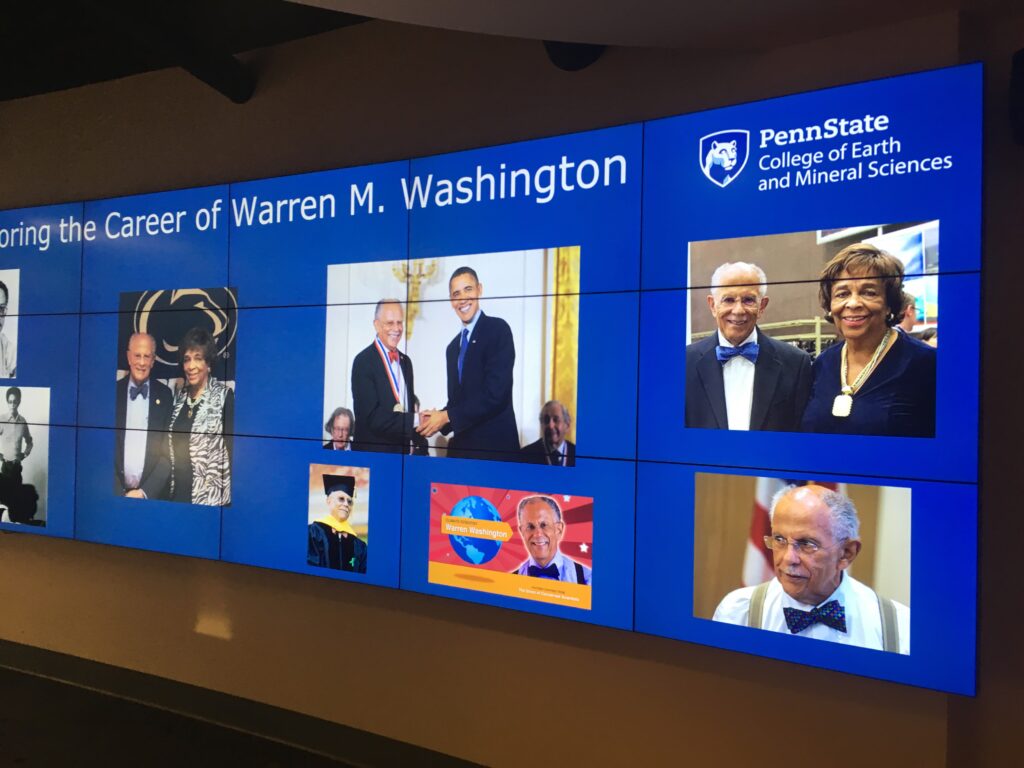
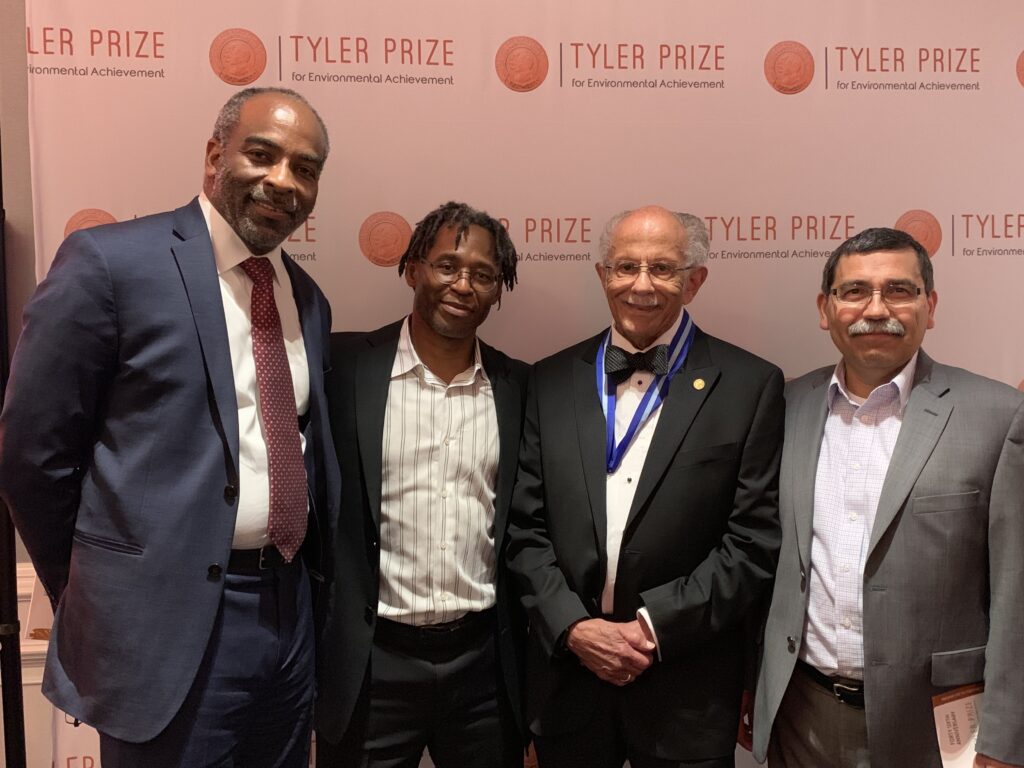
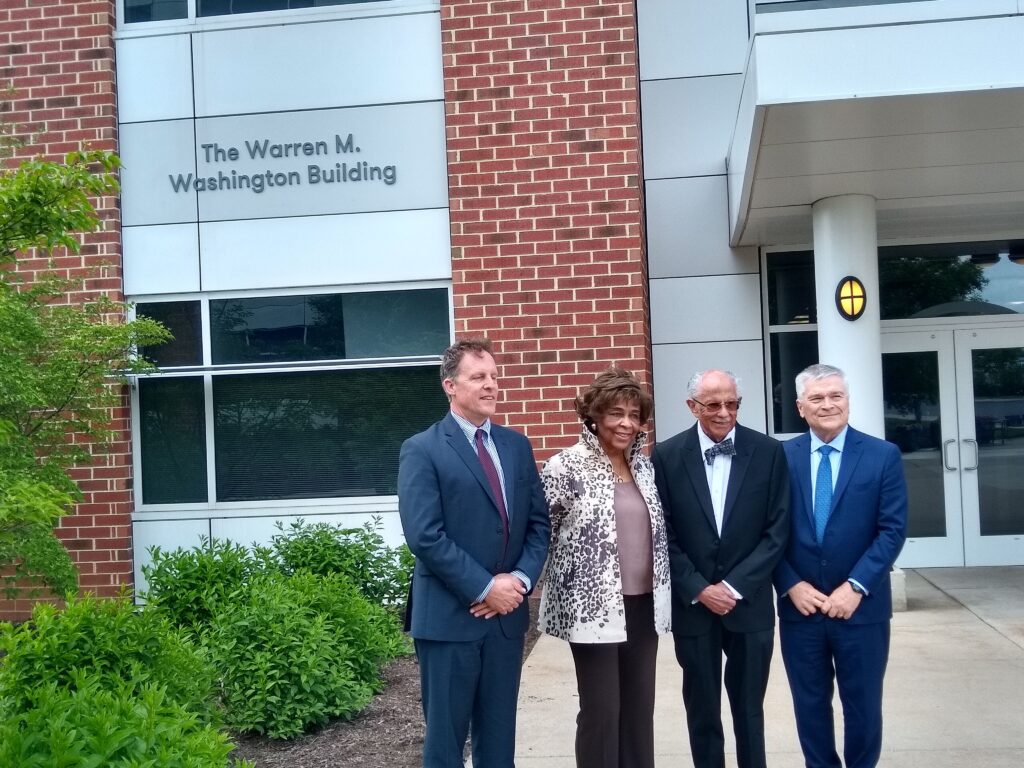
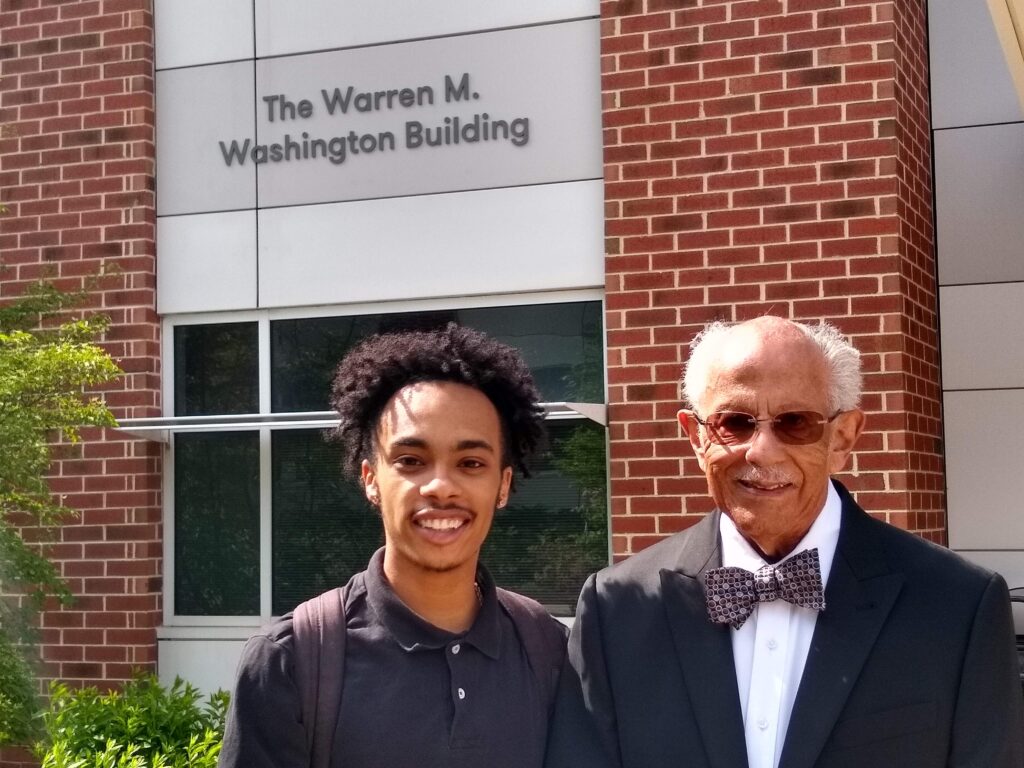
The last five years leading up to Warren’s transition in October have been remarkable. We have honored Warren while he was alive with the Warren Washington Symposium at Penn State, Warren won the Tyler prize in 2019 and there is now a building on campus named after him.
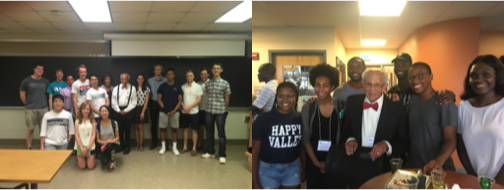
NCAR Director, Dr. Everette Joseph speaks at the Warren Washington SymposiumWarren Washington symposium with former President Eric Barron, the late Fuqing Zhang and me.The weather display reflects Warren’s impact at his symposiumWarren with PSU graduate students and students of color at his symposiumWarren Washington receives the Tyler award with Drs. Everette Joseph, Vernon Morris and Jose Fuentes (2019)Warren and Mary Washington along with Dean Lee Kump and former President Barron for the dedication of the Warren M. Washington Building.
At Warren’s burial site and later in Warren’s office I felt his absence. I wondered if it all comes down to honoring the sacred and silent space of Warren. That sadness lingers within me, but I know that it is not the truth. Warren has left his legacy, with his beautiful children, grandchildren, and great-grandchildren.
Mary and Warren’s two granddaughters.
As for the field, we are sad but thankful for Warren’s mentoring and growing our community. We will follow Warren’s practice and continue to grow, advance knowledge, and protect our communities.
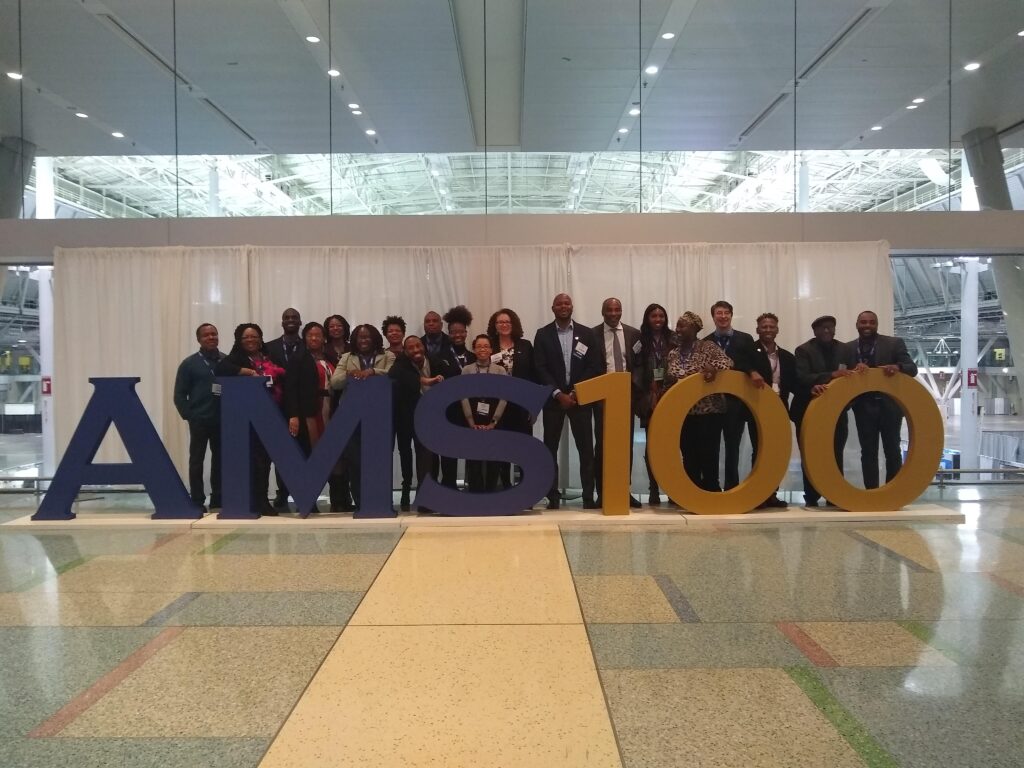
The AMS 100th meeting .
This struggle is not over, and we owe Warren thanks for giving us the tools and will to press forward. We are part of something bigger…
Warren and TaKhari Thompson
We will miss you father, brother, friend, and mentor.
Warren, you are physically gone but will always be our Champion.
Warren thanks for being my research mentor and advisor for the last 35 years. You never led me wrong and were too kind. Your spirit can fly with the ancestors. We will look out for Mary.
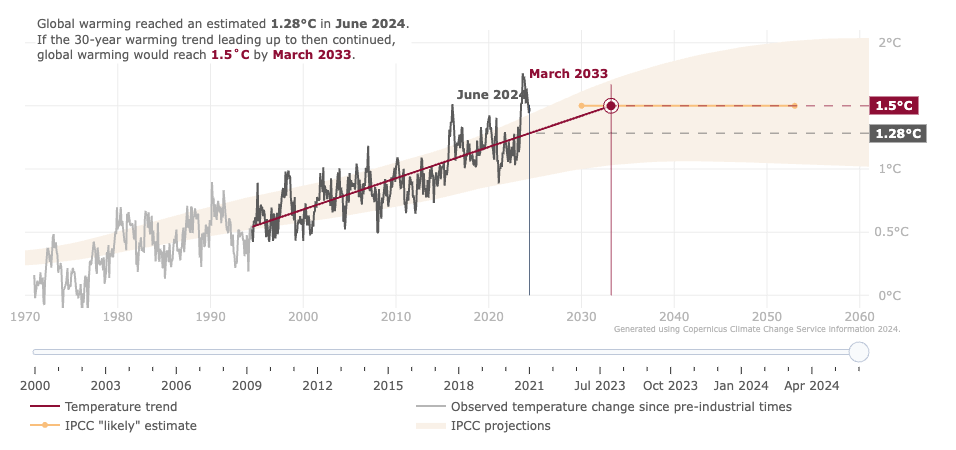
For years, scientists have talked about limiting the warming to 1.5 C as a warning for limiting greenhouse gases. Beyond this point, tipping points are approached with potentially devastating damage. We were on track to reach a point in the 2030s, giving us a little time. But guess what: WE PASSED this point in 2023 and 2024. The warmest temperature on the planet was observed less than 2 weeks ago.
EU Copernicus estimates Temperature increases over time relative to historical periods. the highest global mean temperature was recorded in July of 2024
Why is the OK with our politicians? Why is ok with us? Why is it ok that the young ones being born today will have to grapple with a Climate Crisis every year, month, week, and day of their lives as adults?
Climate change is real and has been popping up in all kinds of ways for the last few decades, but especially during the last year. This has been the warmest year on record, globally, nationally, states, and locally. The presidential candidates have spoken about issues of the day – migration, inflation and the economy. But the big dog is lurking right behind us (tens of millions in the US and billions globally) — Climate Change.
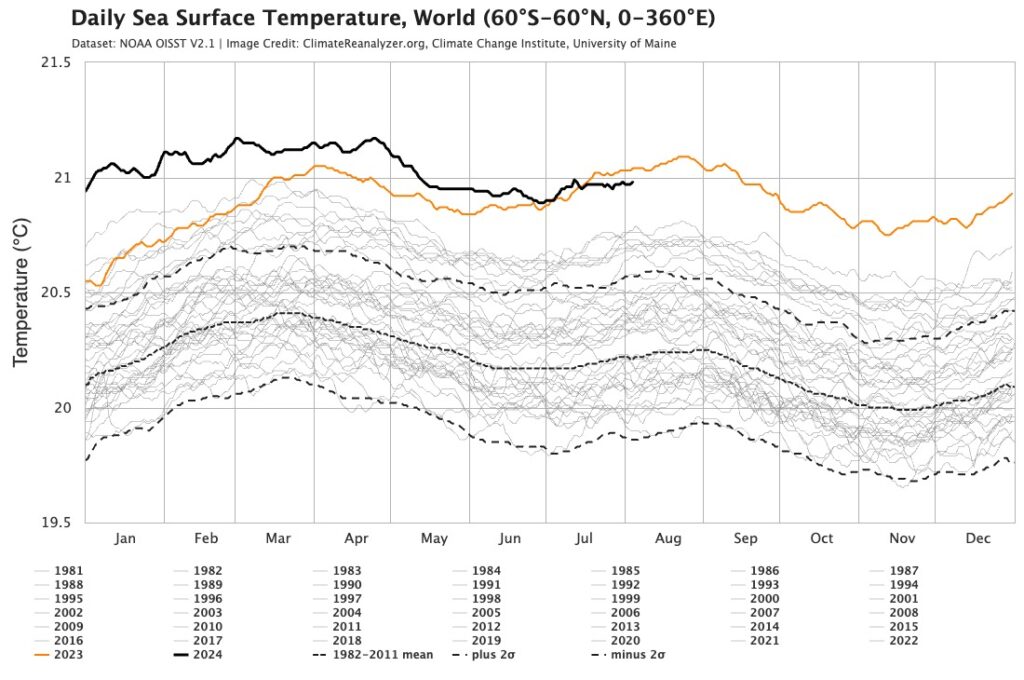
Some of you are thinking… the global mean temperatures will revert back to past time, right? Well, I have some bad news for you. It has not reverted back in more than 40 years. Furthermore, a big jump in ocean temperatures has been behind the recent warming and not just El Nino. Most of the oceans around the globe have warmed. Well, the ocean is like a huge bathtub of warm that will not cool down quickly, and because Greenhouse gases (GHGs) are only increasing and trapping infrared radiation, it is acting to keep the ocean from cooling down. There are few scientists in the world who can tell you why the oceans have warmed up over the last 2 years without talking about anthropogenic GHGs.
I know that President Biden is aware of the situation and has implemented policies to address GHG emissions, but along the way has had to compromise. That is nice politically, but the climate system doesn’t care about politics, wars, or anything else except the GHG forcing that humans are imposing on it. It will respond, and when it does there is no comeback, only reaction.
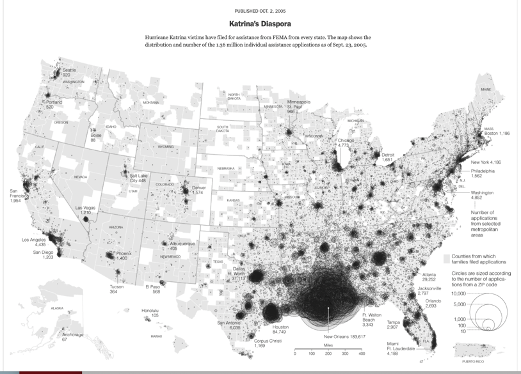
People are worried about the economy, but the many billion-dollar disasters are also taking their toll right here in America. People are worried about migration. Guess what, the climate crisis is already forcing people to migrate all around the world. What’s more, we already know what climate migration looked like in New Orleans after Hurricane Katrina.
The US and Europe want their borders closed. Keep playing with this climate crisis, and you won’t be able to stop anyone because you won’t know which direction they are migrating from. In the US, you gonna have this problem at the state level because people will be migrating within the US. Who knows, maybe Americans will be migrating north across the border into Canada because of the climate crisis.
President Trump has vowed to “drill baby drill” from day one. That’s a bad idea, sir. We have to go the other way and fast so that future generations won’t have to deal with the horrible consequences and also the costs of a much warmer planet. Trump, who is on your science team? They aren’t telling you the truth. You need to fire them.
This upcoming week, Tropical Cyclone Debby will make landfall in Florida. Well that is normal this time of year, but take note of two factors… rapid intensification and the flooding that is expected. On Saturday, at landfall the max winds were about 65-75 MPH and today it expected to be stronger at landfall.
NOAA’s satellite image of TC Debby, August 4th.
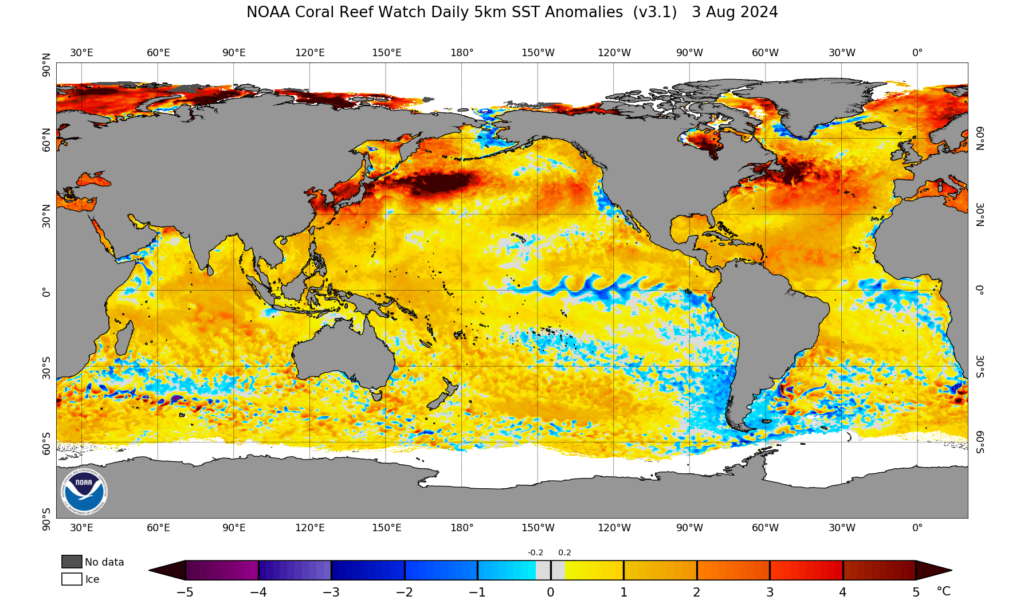
The warming oceans lead to stronger tropical cyclones if conditions such as shear and dry air are not present. The ocean temperature are above normal across most of the Atlantic and Gulf of Mexico.
August 3, 2024 Sea Surface temperature anomalies. Warmer temperatures are yellow, cooler – Blue
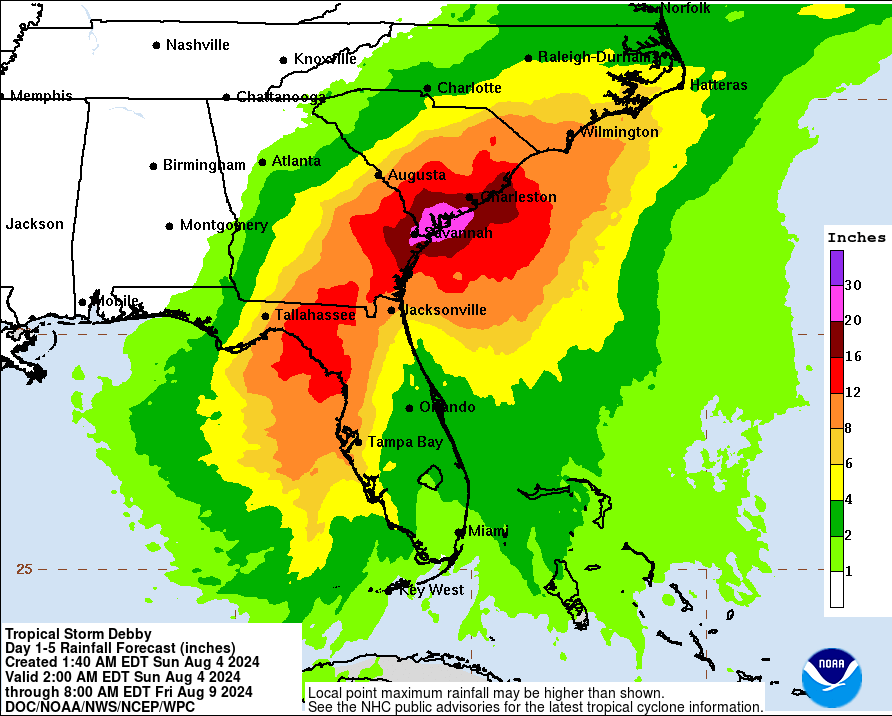
The second issue is the potentially catastrophic rainfall that is expected this week. Once the storm makes landfall, the steering currents aloft will collapse, and the storm will rain out in the SE United States. The forecast does not call for a strong enough trough to move Debby northeast until next weekend. So rainfall amounts of more than 1 foot is possible, and flooding is a beast. Where do you evacuate to?
Rainfall forecast August 4 through Friday August 9, 2024
Flooding could be the real story of this tropical cyclone event . In addition to climate change leading to warmer oceans, which can lead to stronger hurricanes, the atmosphere can hold more water vapor, leading to greater rain amounts.
So I ask, why isn’t climate change a leading topic in this presidential race, at the dinner table, and on the minds of Americans? Let’s see how the climate crisis plays over this week, the hurricane season, and the rest of this year. I have a feeling that the climate crisis conversation is one that we can’t ignore forever.
This year we have observed four named storms. Not a whole lot to write home about, but what is noticeable is that the first two came from Africa… kinda Cape Verde tropical storms. However, consider all the abnormal weather we have seen thus far in the US this summer – dry spells, heat waves, floods, and wildfires. Should you worry about this year’s hurricane season? Based on the trends over the last few years, we should be concerned. However, we also are in an El Nino year, which typically means fewer hurricanes because of increased wind shear. Well, what are the reasons for worry:
Above-normal ocean temperatures
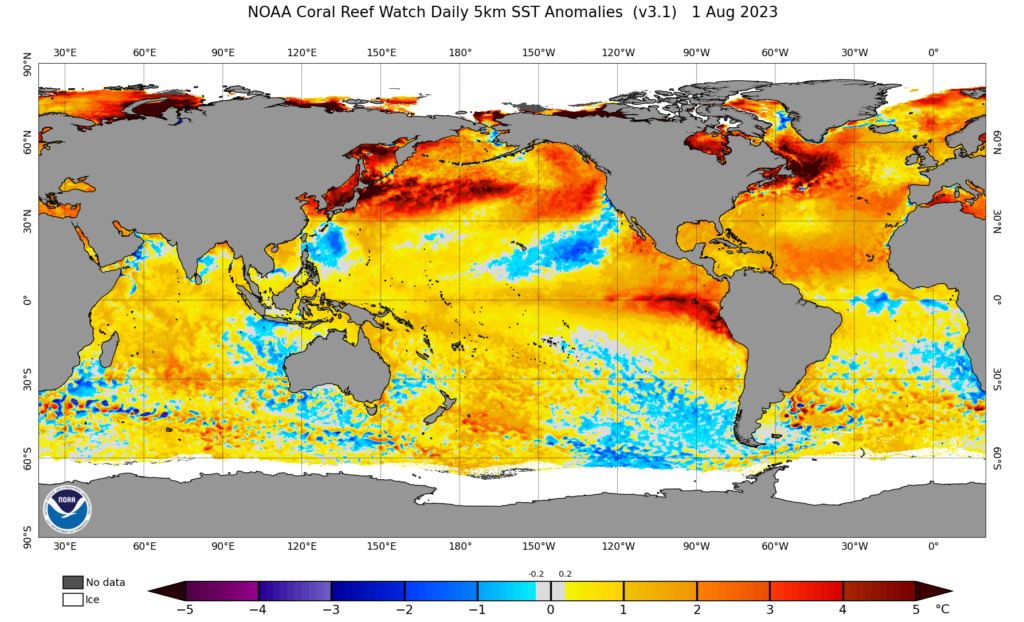
Ocean temperatures across the Atlantic, Carribean warmer across the Atlantic from Africa to the Gulf of Mexico.
NOAA Sea Surface Temperature anomalies (degree C) – August 1, 2023.
As ocean temperatures continue to warm through October, developing tropical cyclones will have warmer than normal waters to pass over possibly leading to stronger TCs. This year oceans in the Northern Hemisphere have been outright warm. Across the tropical Atlantic, the lack of Saharan dust events has also contributed to warmer than normal ocean temperatures, because normally dust scatters sunlight and leading to cooler ocean temperatures.
2. The West African Monsoon is active
We are about to enter into the mature phase of the monsoon, which is normally August and September. Consequently, moisture from the Atlantic Ocean and the Gulf of Guinea has been surging to West Africa from the ground through 3000 feet. This will should strengthen westward moving mesoscale convective systems (MCSs), leading to potential flooding in West Africa, and when in phase with emerging African Easterly waves could become tropical depressions soon after leaving the coast of West Africa.
3. African Easterly waves are looking stronger over West Africa
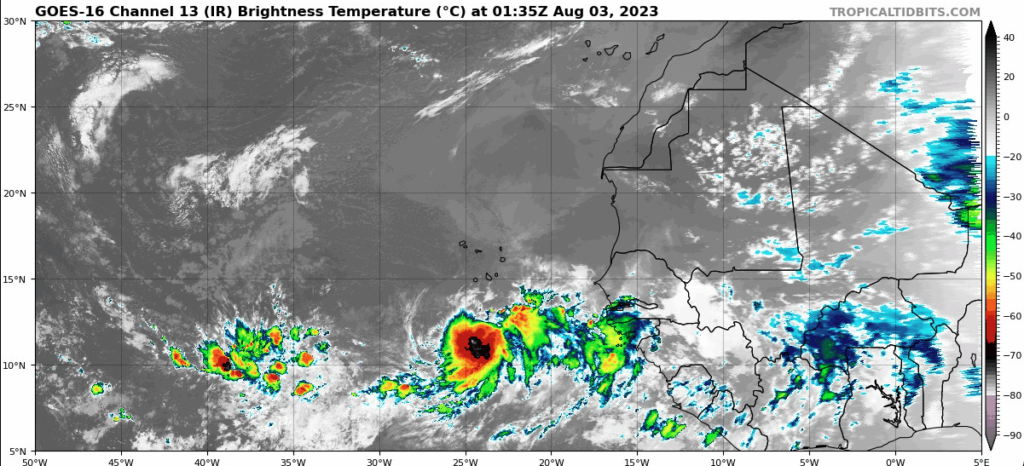
Normally during the second to fourth week of August, AEWs become apparent as they cross Nigeria as well-defined circulations at about 10,000 feet. Over the last few years, there has been a combination of the typical AEWs and the generation/intensification of waves just off the coast, because of fast-moving winds that generate spin (vorticity). Thus far, the second type of wave generation has been occurring with a disturbance currently developing off the coast of West Africa from the satellite vantage point this evening.
Caption: GOES 16 Image showing emerging disturbance off the coast of West Africa (Wednesday 21:35 EDT).
However, at the beginning of this week, models began to forecast well-defined AEWs moving across Chad into Nigeria and moving westward. It could mean that we are ahead of the curve and should expect the stronger wave activity to commence.
Prepare just in case…. OK
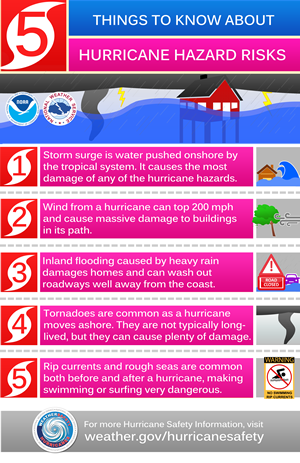
No matter where you are, you should be thinking about the impacts of tropical cyclones during the climate crisis. A hurricane does not need to make landfall in your location to cause major problems. Flooding is a important outcome of decaying tropical cyclones and can be very damaging and also lead to loss of life. Wind damage and storm surge for those living near the coast are primary threats. Below are the five Hurricane hazard risks
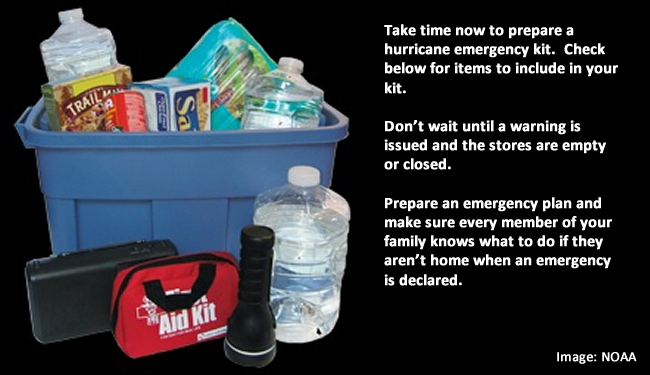
Finally, think about putting together a hurricane emergency kit and make sure you consider children, the elderly, and pets. Now is the time!
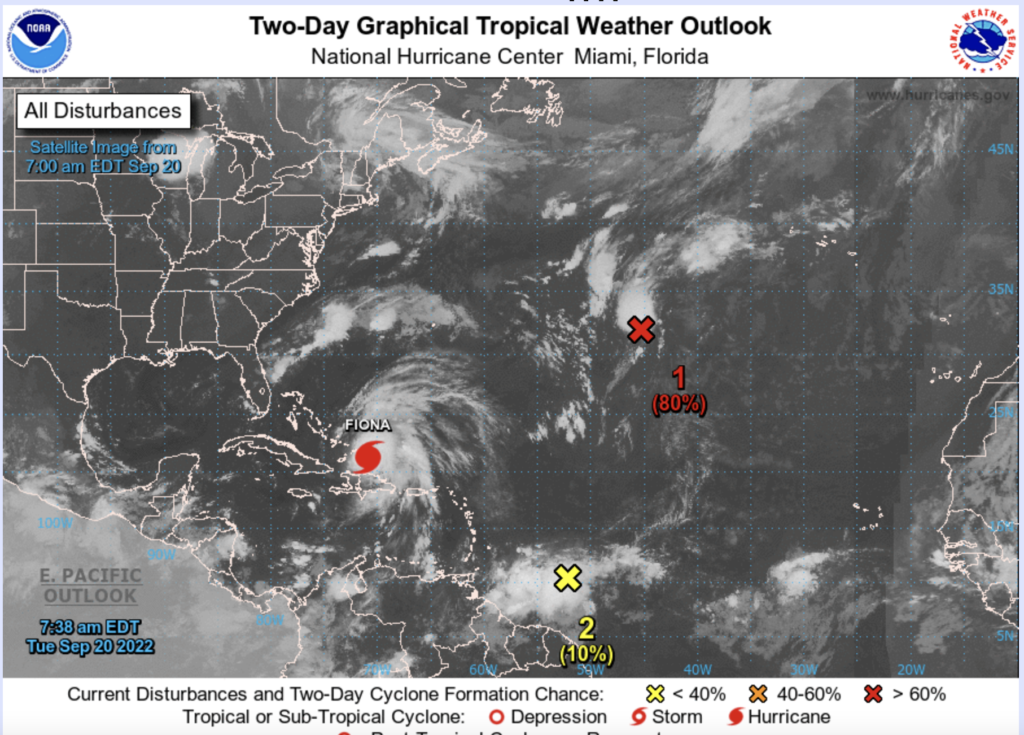
Over the last 10 days, disturbances from West Africa have moved into the Eastern, Central, and Western Atlantic. Unlike the month of August, the waves have not dissipated but continued westward, even in the face of vertical shear. The formation of destructive Hurricane Fiona was such an example. Two additional waves over the Central and Western Atlantic have the chance to become tropical systems over the next 7 days. A third wave situated near 30 W also has a chance to develop. So September might turn out to be quite different from August.
Tuesday Sept 20 NHC 8 AM tropical outlook. 4 potential waves may form tropical cyclones in the coming days
The Source of a Flooding Threat for Senegal
On Monday evening, a new and potentially powerful African Easterly Wave is moving across Burkina Faso and bringing rain over the Central Sahel region. Since last week, global models have identified this feature as a possible tropical cyclone once it exits into the Atlantic. But prior to the AEW leaving West Africa, all indications are that the disturbance will first cross Senegal. The system is expected to bring heavy rain and strong winds to Senegal and the extreme Eastern Atlantic Ocean.
Time of dangerous weather in Senegal
As you may know, tropical rainfall amounts are difficult to predict because of the smaller scale (meso-scale). However, the global models and WRF suggest that heavy rain could begin entering Senegal as early as tomorrow as the wave moves westward. Tomorrow night (Wednesday 21, Sep) through Thursday (22 Sep) look like potentially big impact days with heavy rain moving into Senegal as the system exits the coast.
Monday, Sept 19 WRF simulation of 700 hPa streamlines and Radar Reflectivity.
Any Impacts for Cabo Verde ?
It is still too early to tell, but the global model and WRF suggest that the wave will get pulled north because of a mid-level trough at 500 hPa and not strike the country. Still, this tropical disturbance may have an impact on artisan and commercial fishing along coastal Senegal and Mauritania. There is a possibility that it could become a tropical depression or storm before weakening through shear
WRF September 19 1200 UTC Simulated Sea level pressure and winds
Key Takeaways
Flooding and severe weather possibilities in Senegal will increase starting Wednesday, Sept 21 through Thursday, Sept 22;
Rainfall could be heavy during the night-time hours of Wednesday and Thursday;
A tropical depression is possible off the coast of Senegal/Mauritania;
At present, the event might miss Cabo Verde, but some monitoring and awareness of the event are required through Friday, Sept 23;
Wave activity is still active and likely to impact land areas of West Africa, Cabo Verde, and downstream over the Western Atlantic and the Gulf of Mexico in the coming weeks.
Over the last week, there have been regular African Easterly Waves that have crossed the West African Coastline. These waves have brought some flooding rains to Senegal and plentiful rains to Cabo Verde, where the country has been in a multi-year drought. All of the global models have suggested that a wave would move off the coast yesterday bringing some rain to Cabo Verde.
Infrared Image of Convection with deep convection just south of Praia, Cabo Verde
Forecasting Flooding
Forecasting rain amounts for Cabo Verde is extremely difficult because of the lack of understanding in relationship to the ocean and the limited observations related to the center of the disturbance. In addition, Cabo Verde has high mountains which can cause even deeper thunderstorms, heavy rain and mudslides. The lack of a radar, does not allow us to really know where the heaviest rain is falling across the islands. As we have seen in the US, Pakistan, Senegal and other locations around the world, flooding is increasing, causing fatalities and destruction… with a possible connection to climate change.
The next 36 hours
The wave that emerged from West Africa is expected to slowly move across the country of Cabo Verde bringing heavy rains across the country tomorrow. Where exactly… Most likely the southern Islands tonight and tomorrow.. and extending to the north and west tomorrow into Wednesday. An area of Low pressure in the global and WRF model is expected to traverse the country tomorrow. The low is not very deep so that we do not expect very strong winds. That said, there is still always some uncertainty about potential tropical cyclone development.
ECMWF Monday 1200 UTC forecast of a surface low over Cabo Verde on Tuesday, 1200 UTCWRF Monday 1800 UTC intialized Sea Level Pressure
How much Rain ?
Global models are estimating 1-3 inchest of rain across the country through Wednesday. However, because of the slow movement and the terrain in Cabo Verde there could locally be more… (3+ inches) through the next 36 hours. We just have to see what happens tonight. The WRF model suggest more rain on Tuesday rather than tonight…. But the satellite shows deep convection building tonight.
WRF forecasted 36 hour simulated Radar reflectivity (DBZ) based on Monday 1200 UTC initialization
Because of the uncertainty and the fact that the rain will fall during the night-time hours when people are sleeping tonight, there should be some degree of awareness.